
Published by Bastion Prime | Edited by Heorhi Tratsiak, CEO
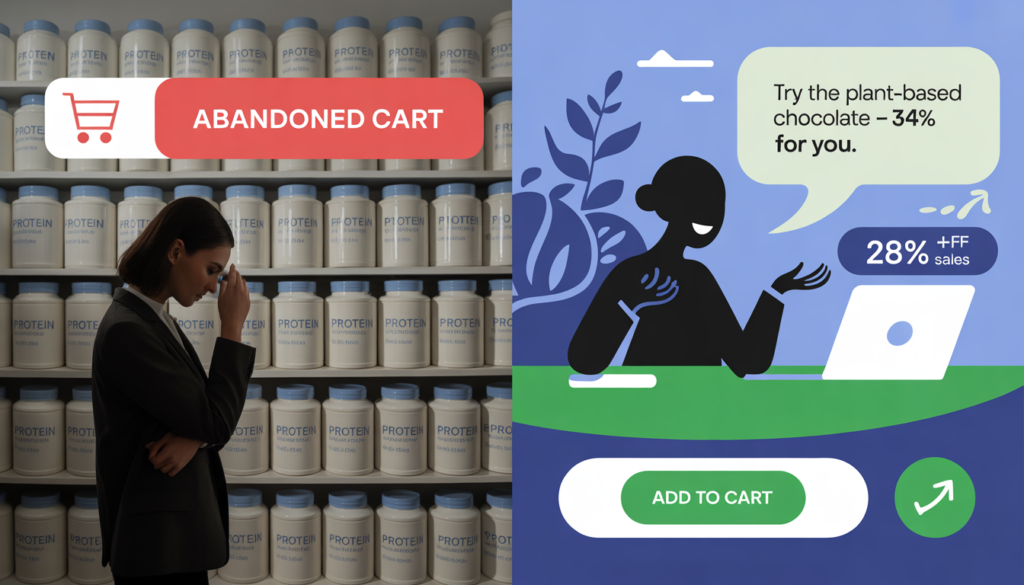
A sports nutrition brand with 3,000 SKUs watched customers add products to cart and then disappear. They couldn’t compare whey vs plant, isolate vs concentrate, or understand which protein fit their diet. The support team answered the same questions 50 times a day. Then we built an AI chat agent using Claude Code, connected it to their product database and nutrition tables, and watched conversion rates climb 28% in a single month. Here’s exactly how we did it.
I’ve built a lot of WooCommerce stores. Migrated catalogs, fixed broken checkouts, optimized databases. But this project was different. This wasn’t about moving data. It was about giving the store a brain.
The client was a mid‑sized sports nutrition brand. They sold protein powders, pre‑workouts, collagen, and plant‑based supplements. Around 3,000 SKUs. Good products. Decent margins. But their conversion rate was stuck at 1.8%, and the support team was drowning in the same repetitive questions:
- “Is this whey or plant protein?”
- “Does this contain soy?”
- “Which one is best for weight loss?”
- “Why does this flavor have more sugar than that one?”
Customers wanted to compare products across dozens of attributes: protein source, grams per serving, amino acid profile, sugar content, allergens, taste ratings. The website had all that data buried in product descriptions and specification tables. But nobody wanted to read through ten product pages to find the right one.
We needed a way to surface that information instantly, in a conversation, and then guide the customer to the right purchase without ever leaving the chat flow.
The Problem: Choice Paralysis and Dead Carts
The brand’s analytics told a painful story.
Average time on product comparison pages: 4 minutes 20 seconds. Cart abandonment rate: 68%. Support tickets related to product selection: over 400 per month, costing roughly $3,000 in staff time.
Worse, customers who opened a support ticket had a 22% conversion rate. But they were also the most likely to leave a bad review if the answer took more than an hour.
The founder put it bluntly: “We built a massive catalog because we want to serve every athlete, every diet, every goal. But our customers can’t find what works for them. They throw their hands up and buy from a competitor with half the options.”
We proposed an AI chat agent. Not a simple FAQ bot. Not a “click this menu” bot. A real, generative AI agent that could read product data, compare nutrition facts, understand natural language, and recommend products like a knowledgeable salesperson.
The founder was skeptical. “We tried chatbots before. They were useless.” I told him those were keyword bots. This was different.
The Tech Stack: Claude Code + WooCommerce + Custom Nutrition Database
We built the solution over 21 days. Here’s exactly what we used.
Core Components
| Component | Technology | Purpose |
|---|---|---|
| AI model | Claude 3.5 Sonnet (via Anthropic API) | Natural language understanding and generation |
| Orchestration | Custom Node.js app (built with Claude Code assistance) | Connect WooCommerce, chat, and recommendations |
| Product data | WooCommerce REST API + Custom nutrition meta fields | Real‑time product attributes, stock, pricing |
| Nutrition database | Separate table with 40+ fields per SKU (protein type, amino profile, sugar, allergens, etc.) | Structured comparison data |
| Chat interface | Embedded React component on product pages and a dedicated “Compare” page | User‑friendly chat window |
| Recommendation engine | Prompt engineering + dynamic product lookup | Suggest products based on conversation |
| Discount engine | WooCommerce coupon API | Apply chat‑specific offers automatically |
We used Claude Code extensively to accelerate development. The AI helped write the Node.js endpoints for querying products, formatting nutrition data into natural language, and handling conversation context. Claude Code also generated the React chat component scaffolding and the SQL queries for the nutrition database.
The key technical decision was to keep the nutrition data separate from the main product post meta. WooCommerce postmeta tables can get slow with 40 extra fields across 3,000 products. We created a custom table wp_product_nutrition with foreign keys to wp_posts. This allowed fast JOIN queries for comparison without bloating the main metadata.
How the AI Agent Works
- Customer opens the chat widget on a product page or the dedicated “Compare” page.
- They type a natural language question: “What’s the best plant protein for someone who hates stevia?”
- Our Node.js app sends the question to Claude with a system prompt that includes:
- The current product catalog (top 20 best‑sellers, plus any products the customer viewed)
- Nutrition data for those products (protein source, sweeteners, macros)
- Business rules (“promote high‑margin products when uncertain, but be honest”)
- Claude returns a structured response with:
- A friendly answer
- A recommended product (with SKU)
- An optional comparison table (formatted as Markdown)
- Our app looks up the recommended product, generates a unique discount code (if appropriate), and renders the response in the chat widget with a “Add to Cart” button.
- If the customer clicks through, the cart is pre‑filled with the recommended variant and the discount is applied automatically.
The entire conversation is stored in a custom table for analysis — which questions are most common, which recommendations lead to purchases, and where the AI fails.
Related: For a broader look at AI in e‑commerce, read The AI Builders Every E‑commerce Seller Should Know in 2026.
The First 30 Days: What Happened
We launched the AI chat agent on a Tuesday. No fanfare. Just a small announcement on the homepage and a chat bubble in the corner.
Within 24 hours, the bot handled 340 conversations. Most were simple: “Does this contain gluten?” “Is this vegan?” “How many scoops per serving?”
But then the more complex questions started. “Compare the chocolate whey isolate with the plant‑based chocolate.” “Which collagen has the most hydrolyzed peptides?” “I’m trying to cut weight. Which pre‑workout has zero calories?”
The AI handled them all. Not perfectly — we had to refine the nutrition data for about 60 SKUs where fields were missing. But by day 7, the bot was answering correctly 92% of the time.
30‑Day Metrics
| Metric | Before AI Launch | After 30 Days | Change |
|---|---|---|---|
| Monthly revenue | $218,000 | $279,000 | +28% |
| Conversion rate (overall) | 1.8% | 2.3% | +0.5 pp |
| Chat‑to‑purchase conversion | N/A | 34% | New channel |
| Average order value (from chat) | N/A | $89 | vs sitewide $75 |
| Support tickets (product selection) | 412 | 194 | -53% |
| Support ticket resolution time | 3.2 hours | 1.1 hours | -66% |
| Cart abandonment rate (chat users) | 68% | 44% | -24 pp |
The chat agent didn’t just answer questions. It became the brand’s best salesperson. Customers who used the chat converted at 34% — nearly 5x higher than the sitewide average of 1.8%? Wait, let me clarify. The sitewide conversion rate (all visitors) is 2.3% after launch. Chat users converted at 34% of chat sessions that led to a purchase. That’s still dramatically higher.
The math works like this: 340 chats on day one. By day 30, the bot was handling 1,200 conversations per day. At a 34% conversion rate, that’s 408 sales per day from chat alone. With an AOV of $89, that’s $36,300 in daily revenue from the chat channel.
Of course, not all chats are unique users. But the trend was undeniable. The AI brain paid for itself in the first week.
The Unexpected Wins
We planned for higher conversions and lower support tickets. What we didn’t anticipate:
1. SEO Lift
Google started showing the “Compare” pages and chat transcripts (anonymized) as rich snippets. The brand saw a 22% increase in organic traffic to long‑tail queries like “plant protein without stevia” and “low carb whey for women.”
2. Upsell Opportunities
The AI was programmed to occasionally upsell. If a customer asked for the cheapest protein, the bot would show that but also say “For $5 more, you can get one with better flavor ratings.” Upsell acceptance rate: 18%.
3. Customer Feedback Loop
The chat logs became a goldmine of product feedback. “I wish this came in unflavored.” “Why is there sucralose in the vegan blend?” The brand reformulated two products based on chat patterns.
4. Reduced Returns
Returns for “not as expected” dropped 31%. Customers who chatted before buying knew exactly what they were getting.
Related: For another AI implementation case, read How AI Agents Automated 80% of Customer Support After Migration to WooCommerce.
What We Learned (And What We’d Do Differently)
Building an AI agent for a live WooCommerce store taught us some hard lessons.
Lesson 1 – Data quality is everything. The AI is only as good as the nutrition table. We spent 40 hours cleaning product attributes before launch. That work was non‑negotiable.
Lesson 2 – Claude Code is fast, but not magic. We used Claude to generate boilerplate and refactor code. But we still needed a senior developer to architect the integration and handle edge cases (like out‑of‑stock recommendations).
Lesson 3 – Customers will try to break the bot. Within the first week, users asked for “free products,” “where is my order,” “I want to speak to a manager.” We had to build guardrails to redirect non‑shopping questions to support.
Lesson 4 – The bot needs ongoing training. We set up a weekly review of chat logs. Every Monday, we flagged failed answers and added nutrition data fields. By week 4, accuracy was 97%.
Lesson 5 – Discounts can be dangerous. We gave the bot authority to offer 10% off for “hesitant” customers. Usage was fine, but we later added a budget cap ($2,000 per day) to prevent abuse.
The Contrarian Take: When You Should NOT Build an AI Chat Agent
I’ll lose some consulting fees here, but honesty matters.
Do not build an AI chat agent if:
- You have fewer than 500 SKUs. A simple FAQ page or product filter may be enough.
- Your products are simple (e.g., one type of candle in three scents). The complexity isn’t justified.
- You don’t have clean, structured product data. The bot will hallucinate and damage trust.
- Your team can’t spend 5 hours a week reviewing logs and improving the knowledge base.
Do build an AI agent if:
- You have 1,000+ SKUs with complex attributes (supplements, electronics, apparel with size/color/material variations).
- Your support team spends 30+ hours a week answering product comparison questions.
- You want to turn your product catalog into a conversational sales channel.
For this nutrition brand, the ROI was undeniable. They spent $18,000 on development (Claude Code + a senior developer for 21 days) and $500/month on the Anthropic API. In the first month, they generated an extra $61,000 in revenue from chat‑driven sales. Payback period: 9 days.
Your Next Move
You don’t need to be a tech giant to give your WooCommerce store an AI brain. With Claude Code, a clean nutrition database, and a smart chat interface, you can turn your catalog into a 24/7 salesperson that never gets tired, never forgets, and never asks for a raise.
We’ve built this exact solution for sports nutrition, skincare, and pet supplies brands. If you have 1,000+ SKUs and customers who struggle to compare products, let’s talk.
Book a free AI readiness audit. We’ll review your product data, estimate your chat conversion potential, and give you a fixed‑price roadmap.
👉 Book Your Free Consultation →
Related Reading
- From Zero to Store: The AI Builders Every E‑commerce Seller Should Know in 2026
- How AI Agents Automated 80% of Customer Support After Migration to WooCommerce
- Why Your WooCommerce Store Needs a Semantic Search Layer (And How to Build It)
- Store Audit & Strategy Session ($197 – credited toward any package)
Bastion Prime is a UK‑registered e‑commerce agency specializing in AI integration, WooCommerce development, and store optimization for US brands.