
Published by Bastion Prime | Edited by Heorhi Tratsiak, CEO
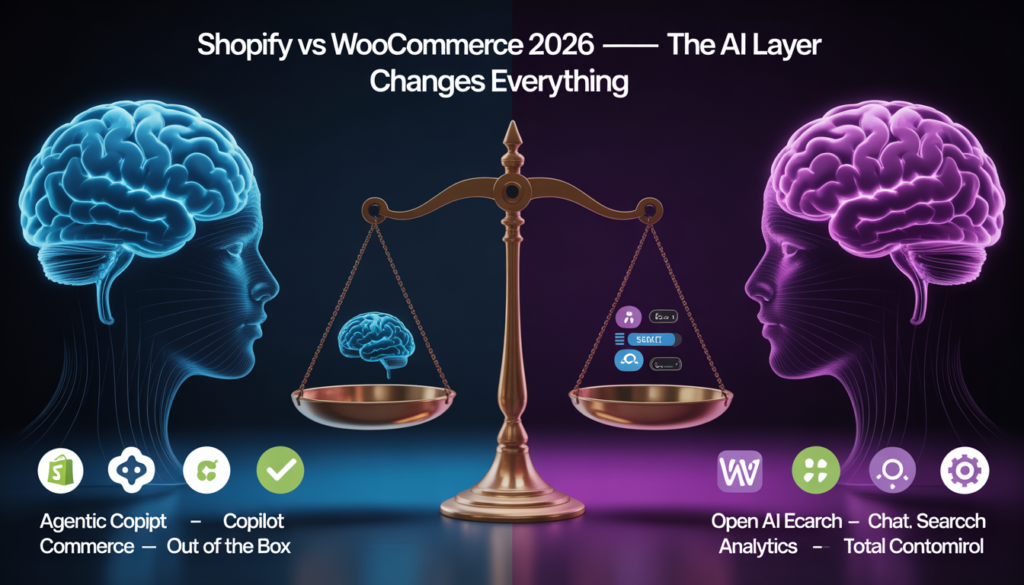
You think the Shopify vs WooCommerce debate is about monthly fees and checkout speed. It’s not anymore. The question in 2026 is: which platform can your AI agent actually talk to? Because in the next two years, most of your customers won’t type into a search bar. They’ll ask ChatGPT, “Find me a leather bag under $200 with fast shipping.” And whichever platform makes it easiest for an AI to find, compare, and buy will win. Here’s what both platforms get right — and where one is pulling ahead.
Let me be clear: both Shopify and WooCommerce are excellent e-commerce platforms. They’ve each built powerful ecosystems. But the AI layer changes everything.
Shopify is betting billions on a centralized, polished, out‑of‑the‑box AI experience. It’s already showing up in ChatGPT searches and giving merchants an AI co‑pilot called Sidekick. WooCommerce is taking the opposite route: an open, decentralized, developer‑friendly AI ecosystem that lets you build exactly what you need, but with more moving parts.
Which one wins depends entirely on your business. Let’s break it down.
The New Frontier: What “AI in E‑commerce” Actually Means in 2026
Before comparing, let’s be specific. The AI layer has three parts:
- Agentic Commerce – AI shopping agents (ChatGPT, Copilot, Perplexity) that research and buy products on behalf of customers.
- Admin AI – Tools like Shopify’s Sidekick that help you (the merchant) manage inventory, write product descriptions, and optimize listings.
- Frontend AI – Chatbots and recommendation engines that talk to customers on your site, answering “Is this vegan?” or “Which size fits me?”
Leading platforms now compete on how well they support all three – and the gap between Shopify and WooCommerce has never been wider or more interesting.
Shopify: The Integrated, Agent‑First Powerhouse
Shopify has bet big on becoming the go‑to platform for AI e‑commerce. It’s advancing on all three fronts.
Shopify’s Admin AI: Sidekick
Sidekick is Shopify’s built‑in AI assistant. It lives inside your Shopify admin, connects to your live store data, and can actually execute tasks, not just answer questions. The 2026 “Renaissance” update turned Sidekick into a proactive business partner. It can:
- Build custom apps based on a natural language description
- Create automation workflows (“Send a message when a preorder ships”)
- Generate AI product descriptions and email campaigns
- Run A/B tests on promotions before you go live
- Provide real‑time analytics (“Why did sales drop yesterday?”)
Sidekick works because Shopify has a unified data model. Returns, analytics, and inventory all sit under one roof, so Sidekick can analyze everything without needing to connect separate plugins. This is its killer advantage.
Agentic Commerce: Discoverable Inside ChatGPT
Shopify’s most forward‑looking move is Agentic Storefronts. Since March 2026, every Shopify store is automatically discoverable inside ChatGPT, Microsoft Copilot, and Perplexity. Customers can ask ChatGPT for product recommendations, and Shopify products appear in the conversation. Purchases happen on the merchant’s store (not directly inside the chat), but discovery happens inside the AI.
Merchants don’t need to build anything. It’s opt‑out, not opt‑in. This is a massive distribution advantage.
Shopify is also deeply invested in the Universal Commerce Protocol (UCP). Thousands of Shopify stores already have UCP manifests discoverable by AI agents. Shopify’s implementation is fast and ready out of the box – no custom development required.
The Trade‑Offs: Centralization and Cost
Shopify’s AI features are polished but rigid. Customizing how an AI agent interacts with your store, or building a unique pricing engine, is difficult. Sidekick’s deeper capabilities (custom app generation, advanced automation) are limited to Shopify Plus. Most Shopify AI features are included but may require higher‑tier plans. What you gain in ease of use you lose in control.
Related: Learn more about Shopify’s hidden transaction fees in The Hidden Cost of Shopify’s Transaction Fees.
WooCommerce: The Open, Flexible AI Ecosystem
WooCommerce’s AI strength isn’t polish. It’s flexibility and depth. You can build anything, but you have to assemble it yourself.
Open Source AI Ecosystem
WooCommerce doesn’t have a built‑in Sidekick. Instead, you add AI capabilities through plugins. The plugin ecosystem is large, diverse, and surprisingly mature:
- ShopBot AI – Adds an intelligent chatbot powered by Claude AI that answers product questions, shipping policies, and returns – and automatically learns from your catalog.
- PlugnAI – Adds an AI shopping assistant like Amazon’s Rufus, with product discovery, side‑by‑side comparisons, and automatic catalog sync.
- IntelliAgent AI Lite – Adds a GPT‑powered chat widget that can pull real‑time product data and offer recommendations.
- AICA – Smart AI Commerce Assistant – Supports OpenAI, Claude, and Gemini models.
The WooCommerce approach is more work upfront but offers more choice. You can swap providers, run multiple AI models, and customize every interaction.
Agentic Commerce with MCP
WooCommerce now features an experimental Model Context Protocol (MCP) that allows AI agents to interact directly with your store, find products, and initiate checkouts on behalf of users. This is the same underlying technology powering Shopify’s agentic features, but it’s open and customizable.
When it comes to protocol depth, WooCommerce has a surprising lead. According to recent UCP data, WooCommerce stores expose eleven capabilities to AI agents, versus Shopify’s five. Key differences include Identity Linking (AI agents can access saved addresses and payment methods for fully autonomous checkout), Embedded Checkout (iframe protocol for payment delegation), and Structured Catalog Search. Shopify’s agentic features are easier to turn on, but WooCommerce offers richer interactions once configured.
The Trade‑Offs: Complexity and Responsibility
WooCommerce’s AI ecosystem requires you to choose and integrate your own tools. An AI agent cannot easily “see” across data stored in separate plugins because WooCommerce’s data is distributed across different tables, making cross‑domain AI analysis more complex to set up. You must invest development time to get UCP working properly; WooCommerce’s default AI readiness is not as turnkey as Shopify’s.
But if you have a developer, the flexibility is unmatched.
Related: For step‑by‑step instructions on deploying a WooCommerce AI assistant, read our guide AI Shopping Assistants Are Coming for Your Store. Here’s How to Deploy One in a Weekend.
Head‑to‑Head: AI Capabilities Compared
Let’s put this side‑by‑side.
| AI Capability | Shopify (2026) | WooCommerce (2026) |
|---|---|---|
| Built‑in admin AI | ✅ Sidekick – proactive, can execute tasks | ⚠️ Requires third‑party plugins (e.g., Jetpack AI, AI Power) |
| Agentic Commerce ready | ✅ Agentic Storefronts enabled by default | ⚠️ Requires plugin; experimental MCP available |
| Discoverable in ChatGPT | ✅ Yes – all stores automatically discoverable | 🟡 Only with specific plugin |
| UCP capabilities depth | 5 capabilities (breadth over depth) | 11 capabilities (depth over breadth) |
| Identity Linking (OAuth) | ❌ Not yet supported | ✅ WooCommerce supports |
| Embedded Checkout | ❌ Not yet supported | ✅ WooCommerce supports |
| Ease of setup | ✅ Out of the box, minimal effort | 🟡 Requires plugin installation and configuration |
| Custom AI logic | Limited to what Shopify provides | ✅ Full control via open APIs |
| Cost for standard AI | ✅ Most features included in Basic/Shopify plans | ⚠️ Depends on chosen plugins; some ,manyfree/50‑200/year |
| Best for | Turnkey AI readiness, fast deployment | Deep customization, data sovereignty |
The contrast is clear. Shopify wins on ease and distribution. WooCommerce wins on flexibility and depth.
Related: WooCommerce remains the most‑used e‑commerce platform globally, with approximately 33% market share by store count. For quantitative market data, see WooCommerce Statistics You Need to Know in 2026.
The Future of AI in E‑commerce – What Matters Most
The AI commerce world is still young, and standards are rapidly evolving. Protocols like UCP (Google/Shopify/Etsy/Walmart), ACP (OpenAI/Stripe), and MCP (Anthropic/WooCommerce) are competing to become the standard for AI‑to‑store communication. Right now, Shopify stores speak UCP natively, giving them instant access to Google’s AI search ecosystem. WooCommerce stores speak MCP, offering more direct interaction with LLM‑powered agents.
If you want to be discoverable in ChatGPT and Google AI Mode right now, Shopify is the path of least resistance. If you want to build custom, deep agentic interactions and control every part of your AI commerce stack, WooCommerce is the better foundation.
The Contrarian Take – Why the “Winner” Depends Entirely on Your Business
Both platforms will continue adding AI features. If you’re a small to medium brand without a development team, Shopify’s integrated approach will save you months of work. You’ll be AI‑ready on day one and discoverable in ChatGPT before lunch.
If you’re a larger brand with unique requirements – custom product attributes, complex B2B pricing, or data sovereignty concerns – WooCommerce is the only real answer. No closed platform will ever give you the control that open source provides.
The AI layer doesn’t kill either platform. It clarifies their roles. Shopify is brawn – fast, integrated, and ready to go. WooCommerce is brains – deep, customizable, and infinitely adaptable. Choose the one that fits your business, not the one that’s winning the buzzword battle.
Your Next Move
The AI layer isn’t coming. It’s already here. Your customers will soon be shopping through AI agents whether you’re ready or not. The only question is whether your store speaks their language.
Book a free AI readiness audit. We’ll analyze your current platform, your product catalog, and your target markets – then give you a clear roadmap for AI‑powered e‑commerce in 2026.
👉 Book Your Free Consultation →
Related Reading
- How to Deploy an AI Shopping Assistant in a Weekend (2026 Guide)
- The Hidden Cost of Shopify’s Transaction Fees: Why a 50k/MonthStorePays50k/MonthStorePays6k More Per Year
- We Gave Our WooCommerce Store an AI Brain and Sales Went Up 28% in 30 Days
- Low‑Code WooCommerce: Build a Custom Storefront with v0 + AI in One Afternoon
- WooCommerce is Dead. Long Live WooCommerce: How Headless + AI Save the Platform
- Store Audit & Strategy Session ($197 – credited toward any package)
Bastion Prime is a UK‑registered e‑commerce agency specializing in WooCommerce development, AI integration, and headless storefronts for US brands. We don’t pick sides – we build the right solution for your business.
Great breakdown — and the capability comparison table is accurate. The WooCommerce depth advantage is real.
One data point worth adding: houseofparfum.nl scored 100/100 on the UCP Score today, ranking #1 globally above all Shopify stores across 4,608 verified domains. The store runs UCPReady, my WooCommerce plugin.
Your point about “requires plugin installation and configuration” is fair — but the ceiling once configured is genuinely higher than Shopify’s. AP2 Mandates are live on UCPReady right now, meaning fully autonomous payment with no browser redirect. Zero Shopify stores have this yet.
The flexibility advantage you describe isn’t theoretical. It’s measurable today.