
Published by Bastion Prime | E‑commerce Strategy
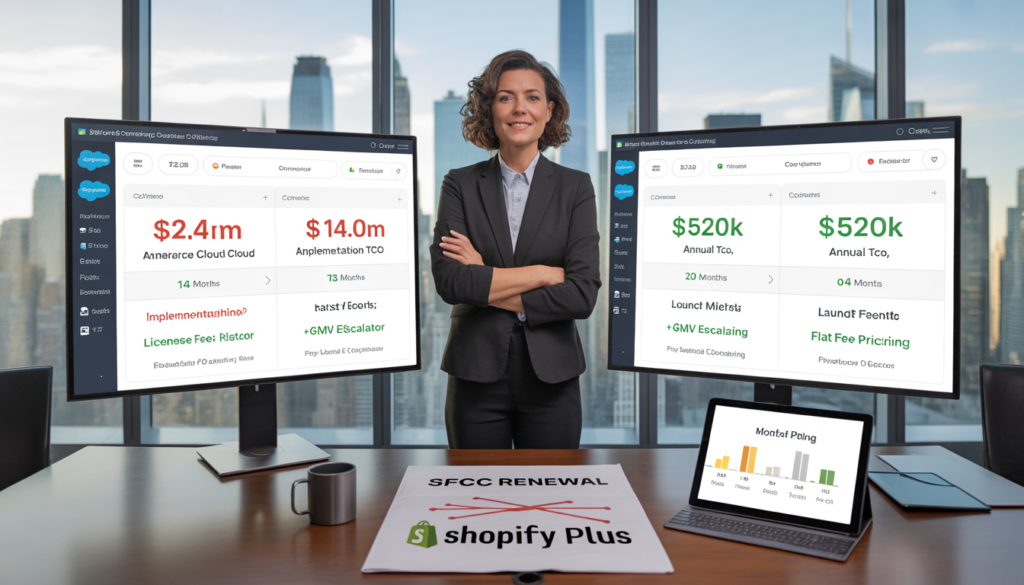
Your $2M annual Salesforce bill is a tax on success. Your developers spend 40% of their time maintaining a platform that was cutting-edge in 2016. And you’ve just discovered that implementing Apple Pay took three months and cost six figures. Here’s why TOMS, Guess, and UrbanStems left SFCC — and the exact roadmap to follow them.
I’ve sat across from enterprise e‑commerce leaders at brands doing $50M to $500M annually. Almost every single one of them feels the same frustration.
Salesforce Commerce Cloud was sold to them as “the gold standard for enterprise e‑commerce.” But a decade later, the reality is different: platform fees tied to GMV, implementations that bleed into year two, and a proprietary ecosystem where finding talent feels like a recruiting nightmare. As one Norwegian outdoor brand put it, SFCC was “too big, too costly, and even though we had good IT people, we were restricted in what we could do ourselves.”
In 2026, the migration from SFCC to Shopify Plus is no longer a fringe decision. It’s a strategic necessity for mid‑market and enterprise brands tired of paying enterprise prices for capabilities they rarely use.
Part 1: The Real Cost of Salesforce Commerce Cloud (The Price They Don’t Show You)
Let me be direct: the sticker price you see on Salesforce’s website is a trap.
SFCC pricing starts around $150,000 to $250,000 annually for mid‑market brands, scaling with GMV. A brand doing $150M in annual online revenue might pay $1.8M to $2.5M per year in SFCC licensing alone, before implementation, customization, or support.
But platform licensing is typically just 15 to 25% of the true Total Cost of Ownership (TCO) for enterprise deployments. Here’s where the rest of your budget actually goes.
Where SFCC Bleeds Your Budget
When you add a managed services partner, integration middleware for NetSuite or SAP, and ongoing cartridge development, total platform spend can approach $4M to $5M annually
This is not a platform. It’s a wealth transfer from your brand to Salesforce’s balance sheet.
Part 2: The Shopify Plus Reality — What $2,300/Month Actually Gets You
Now let’s compare. Shopify Plus charges a flat $2,300/month on a 3‑year term (or $2,500/month on a 1‑year term). Once your store exceeds $800,000 in monthly revenue, pricing shifts to a variable model based on a percentage of sales — 0.35% on a 3‑year term or 0.40% on a 1‑year term, capped at $40,000/month.
For most enterprise brands, the all‑in cost of Shopify Plus — including apps, integrations, and headless front‑end infrastructure — runs 40 to 60% below an equivalent SFCC stack
Here’s what that $2,300 actually covers:
For comparison: a brand doing $150M annually on Shopify Plus pays approximately $504,000/yearin platform fees (0.25% of revenue above $800k/month, capped). The same brand on SFCC pays $1.8M to $2.5M. That’s a difference large enough to fund an entire marketing department.
The Licensing Delta Funds the Migration
We’ve seen brands recoup migration costs within 18 months purely through reduced platform spend. That’s before you account for developer time savings that compound across every sprint.
Part 3: Comparative TCO — SFCC vs. Shopify Plus at Scale
Let me put real numbers on this. Below is a comparison for a mid‑market brand doing $30M in annual online revenue.
These are not hypotheticals. A Shopify partner reported TCO savings ranging from $800k to $11M across 17 brands that migrated from SFCC to Shopify.
When CQL migrated dozens of enterprise brands — including TOMS, Bauer Hockey, and Guthy|Renker — they achieved a 50–75% reduction in implementation time compared to Salesforce Commerce Cloud.
Guess Watches left SFCC due to “technical debt and high total cost of ownership,” replatforming to Shopify to unlock full storytelling potential.
UrbanStems reduced TCO by 15% after migrating from SFCC to Shopify Plus in just four months.
Part 4: The Technical Migration Roadmap (Without Losing Your SEO)
Migrating from SFCC to Shopify isn’t just switching tools. It’s a complete overhaul of your e‑commerce architecture, business processes, and team practices.
Here’s the roadmap that preserves your revenue while you transition.
Phase 1: Pre‑Migration Audit (Week 1–2)
Before touching a single line of code, map exactly what you’re running on SFCC today:
- Catalog structure: categories, attributes, variants. SFCC uses a complex, hierarchical data model; Shopify uses a streamlined, flat structure.
- Customizations: pipelines/controllers, ISML templates, custom scripts, and SiteGenesis vs. SFRA.
- Integrations: ERP/OMS/CRM (SAP, Oracle, NetSuite), payments, taxes, shipping carriers, reviews, loyalty, subscriptions.
- Promotions and price books: SFCC’s engine is very comprehensive — stackable promotions, complex exclusions, tiered pricing.
- SEO: export all
seo‑url‑redirectsfrom SFCC Business Manager. SFCC allows custom URLs, while Shopify enforces prefixes (/products/,/collections/).
Warning: A poorly planned migration can result in 30–40% loss of organic traffic. Conversely, a thorough migration allows recovery within 3–6 months.
Phase 2: Data Model Mapping (Week 3–4)
This is where you translate how SFCC thinks into how Shopify operates.
Phase 3: Build Your Migration Pipeline (Week 5–8)
SFCC uses a proprietary JavaScript variant (Demandware Script), ISML templates, and custom controllers that don’t translate directly to Shopify. You have two main extraction methods:
- Business Manager export jobs: works for products, categories, customers, orders, and content assets.
- OCAPI (Salesforce Commerce Cloud API): for real‑time or complex data pulls.
Critical infrastructure: SFCC customers often have complex integrations (SAP, Oracle). Shopify typically requires middleware. Use an iPaaS (Celigo, Boomi, Make.com, Alumio) to orchestrate data flows. This abstraction layer facilitates future development and keeps backend systems insulated during migration.
Phase 4: SEO Preservation (Non‑Negotiable)
SEO is the silent killer of migrations. Here’s the exact checklist:
- Create a comprehensive redirect plan using 301 redirects. Map every old SFCC URL to its new Shopify equivalent.
- Prioritize high‑value pages — top traffic drivers, most backlinks, highest conversion rates.
- Export all SFCC
seo‑url‑redirectsand map to Shopify’s redirect CSV format. - Preserve metadata: titles, meta descriptions, and structured data (JSON‑LD) must migrate intact.
- Keep slugs if possible. If not, redirect 1:1 from old to new.
- Test redirects before launch to avoid chains or loops.
- Submit new sitemap to Google Search Console immediately after launch.
- Monitor crawl errors daily for the first two weeks post‑migration.
Phase 5: Launch and Post‑Migration (Week 12–16)
Timelines vary by complexity. Standard migrations might take 20–24 weeks, advanced ones 26–36 weeks, and enterprise‑level projects around 42 weeks.
However, with proper planning and iPaaS infrastructure, many brands launch in 4–6 months — significantly faster than the 12+ months typical of SFCC projects.
Post‑launch checklist:
- Run both platforms in parallel during testing
- Monitor order flow, inventory sync, and fulfillment logic
- Verify all redirects are working
- Watch Google Search Console for 404 errors
- Validate checkout flows across all markets
Part 5: Why 2026 Is the Year to Move
Three factors have converged to make SFCC→Shopify migration more compelling than ever.
Factor 1: Shopify Plus Has Matured Dramatically
The objection that “Shopify Plus can’t handle enterprise complexity” was partially valid in 2019. It’s not in 2026.
- Shopify Functions replaced the rigid discount model with a programmable layer that lets engineers write custom checkout logic in Rust or JavaScript, deployed serverlessly.
- Hydrogen and Oxygen give you a headless React framework with edge‑deployed rendering and native Storefront API integration.
- Shopify Markets handles international selling — local currencies, languages, dedicated domains, differentiated pricing — from a centralized interface. Markets Pro manages customs duties and tax compliance.
- Winter 2026 Edition introduced over 150 new features, including AI‑powered Sidekick, native A/B testing, and significant B2B‑specific enhancements.
Factor 2: The Talent Gap Is Widening
Developers fluent in Salesforce Commerce Cloud are harder to find and more expensive to retain than developers who work with React, JavaScript, and modern frameworks. Shopify’s technology stack is mainstream. SFCC’s is proprietary.
The talent pool for Shopify developers is vast and growing. The pool for SFCC developers is shrinking.
Factor 3: The ROI Math Has Flipped
According to Gartner Peer Insights, Shopify maintains a 4.6‑star rating with 516 reviews, while Salesforce Commerce Cloud holds 4.4 stars with 169 reviews. More importantly, Shopify delivers 36% higher conversion rates compared to Salesforce, with total cost of ownership 35% lower on average.
The commerce cloud market is growing at 22.8% CAGR, from $30.43 billion in 2025. But the growth isn’t evenly distributed. Shopify now owns approximately 26% market share in e‑commerce platforms, while Salesforce Commerce Cloud has captured around 12%.
The momentum is clear. Enterprise brands aren’t leaving SFCC because they’re unhappy with features. They’re leaving because the complexity‑to‑value calculation that made sense in 2018 no longer holds.
The Contrarian Take: When You Should NOT Migrate (Yet)
I’ll lose some consulting fees here, but honesty matters.
Do not migrate from SFCC to Shopify Plus if:
- Your organization has strict global governance requirements that only SFCC’s native compliance coverage can meet (SFCC covers 44 standards including GDPR/ADA; CCPA is a built‑in exception).
- You have deeply embedded, highly customized B2B workflows that would require massive redesign (though Shopify Plus B2B has closed most gaps).
- Your annual online revenue is under $10M — the ROI window is longer, and the complexity may not justify the lift.
- You have an in‑house team of SFCC specialists who would become obsolete, and retraining costs outweigh migration benefits.
For everyone else, the math is clear. The licensing delta alone funds the migration within 12–18 months. After that, it’s pure margin improvement and faster innovation cycles.
Your Next Move
You don’t need to hate Salesforce Commerce Cloud to recognize that Shopify Plus has become the better platform for most enterprise brands. The features are there. The performance is there. The cost structure is dramatically better.
We’ve helped brands navigate this exact migration — from SFCC to Shopify Plus — preserving SEO, migrating complex product catalogs, and keeping ERP integrations intact throughout the transition.
Book a free migration audit. We’ll review your current SFCC setup, model your TCO on Shopify Plus, and give you a realistic 16‑week roadmap. No obligation. Just the numbers.
👉 Book Your Free Consultation →
Related Reading
- Store Audit & Strategy Session ($197 – credited toward any package)
- Don’t Start an E‑commerce Store Until You Read This Margins Report
- B2B E‑commerce: Stop Emailing Spreadsheets
- Your Amazon Seller Account Is Not an Asset
- Growth Package ($3,997) – For Sellers Ready to Scale
- Premium Package ($7,997) – Complete Done‑For‑You Store for Established Brands