
Published by Bastion Prime | Edited by Heorhi Tratsiak, CEO
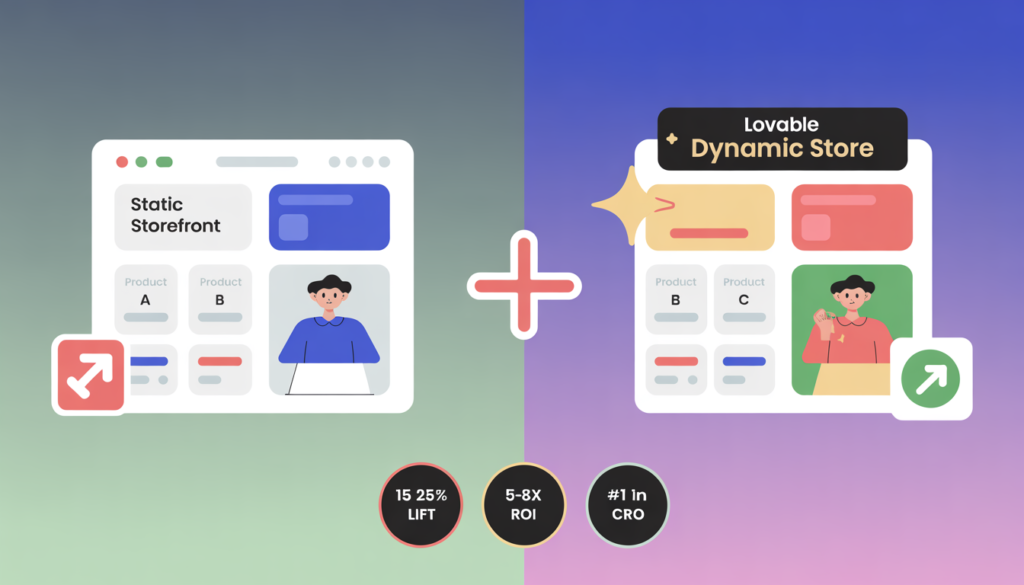
At 2 AM, a customer lands on your store. No one from your team is awake. No chatbot nudges them. No personalized offer appears. They scroll, pause, compare, hesitate — and leave. That moment isn‘t a failure of your products. It’s a failure of your technology to react. Static, one‑size‑fits‑all storefronts treat every visitor identically. They don‘t know that one shopper is a first‑time mom looking for organic baby lotion, while another is a repeat buyer searching for bulk coffee. And in 2025-2026, static stores simply can’t keep up. Here’s how Lovable gives your storefront real‑time personalization — and why your conversion rate will thank you.
Most e‑commerce stores are built like a traditional supermarket aisle. The layout is fixed. The products on the shelf never change. But what if that supermarket had a personal shopper who noticed you pause in front of the olive oil, then quietly rearranged the shelf to show you the award‑winning varieties and offered a coupon for fresh bread?
That’s exactly what Lovable’s real‑time personalization does for your store.
Traditional e‑commerce platforms deliver static experiences — every visitor sees the same layout, the same products, the same offers, regardless of their interests. AI‑powered personalization changes that. It interprets user behavior patterns, identifies micro‑intent signals, predicts next likely actions, and adjusts the storefront dynamically — all in milliseconds. The old supermarket aisle becomes a personal shopper.
This isn’t science fiction. It’s happening right now with Lovable’s native Supabase integration and AI engine. And the brands that adopt it are already seeing conversion lifts of 15–25% compared to those using generic approaches.
The Cost of Static: What You’re Leaving on the Table
Before we dive into solutions, let’s quantify the problem. In early 2026, most Shopify stores convert between 1.5% and 2.5%. The very best push past 3.2%. That means 97–98% of visitors leave without buying.
Static, unpersonalized experiences are a major reason why.
Consider these 2026 personalization benchmarks:
The gap is staggering. Personalized messages in 2026 see up to a 37.6× conversion lift compared to generic communications. If you’re not personalizing in real time, you’re leaving as much as 97% of your potential revenue on the table.
What “Real‑Time Personalization” Actually Means
Real‑time personalization isn’t just “showing recommended products.” It’s a complete behavioral intelligence layer that transforms how your store interacts with every visitor.
At the data ingestion layer, Lovable continuously imports structured and unstructured data from your store: product metadata, customer profiles, purchase history, and clickstream behavior. Every scroll, hover, and hesitation gets captured.
At the intelligence layer (AI), it applies behavioral modeling, pattern recognition, and predictive analytics. It doesn’t just answer “what did the user click?” It answers “why did they click — and what are they likely to click next?”
At the execution layer, Lovable translates these insights into real‑time recommendations, dynamic UI adjustments, smart search outputs, and trigger‑based interactions — without the customer needing to refresh the page.
The result? A store that adapts to each visitor as they browse. First‑time visitors see beginner-friendly content. Returning buyers skip straight to their favorite categories. Price‑sensitive shoppers get subtle discount nudges. High‑intent users with a history of comparing products receive side‑by‑side comparisons automatically.
This isn‘t a futuristic concept. Lovable’s Shopify integration already delivers real‑time personalization, smarter recommendations, and better conversions for thousands of merchants.
The Technology That Makes It Possible: Supabase Realtime + Lovable AI
Real‑time personalization requires two critical capabilities: live data streaming and instant UI responsiveness. Lovable delivers both through its native Supabase integration.
Supabase Realtime: Lovable’s Supabase Integration 2.0 supports real‑time database updates, enabling users to see changes without refreshing the page. When a customer’s cart updates, inventory changes, or a new discount becomes available, the UI updates instantly. The system also supports background tasks for long‑running operations, allowing more scalable and reliable applications.
React for dynamic UI: Lovable uses React precisely because its component‑based architecture excels at real‑time updates. When a state variable updates, React intelligently re‑renders only the necessary parts of the UI — ensuring smooth, responsive interactions even during high‑traffic events.
Edge Functions for serverless logic: Edge functions handle tasks like sending personalized emails, processing payments, or integrating with external APIs — all without blocking your main workflow.
This combination makes the “magic” of real‑time personalization possible: a customer’s hesitation triggers a personalized discount, delivered instantly through a chat window, without interrupting their shopping flow.
Stop Building Static: How Lovable Solves the 3 Biggest E‑commerce Problems
Lovable’s framework directly addresses the three most common failure points of static storefronts.
Problem 1: Static Experiences
Most e‑commerce sites treat everyone the same. They don‘t react. They don’t adapt. They don‘t keep up with customer intent.
How Lovable fixes it: Dynamic UI adjustments rearrange product grids based on browsing behavior. A customer who lingers on athletic shoes will see more footwear recommendations; one who clicks “men’s formal” will see a tailored selection of dress shoes.
Problem 2: Data Without Action
Stores collect vast amounts of data — but rarely act on it. Clickstreams, wishlist adds, cart pauses — all captured, none utilized.
How Lovable fixes it: The intelligence layer continuously processes behavioral data to predict next actions. When a customer checks a product page twice, compares prices, and saves items to a wishlist, Lovable flags them as having an 80% purchase probability — then triggers a personalized follow‑up offer automatically.
Problem 3: Decision Friction
Customers abandon carts because they can‘t find the right size, can’t decide between two products, or hesitate on price.
How Lovable fixes it: Contextual recommendation systems compare products side‑by‑side, predictive search delivers accurate results even with imprecise queries, and AI‑assisted conversion nudges offer exactly the right incentive at exactly the right moment — without being intrusive.
Real‑World Examples: Personalization That Actually Works
Here’s how brands are using Lovable’s real‑time personalization to drive results:
Intent‑Based Landing Pages: Instead of generic homepage layouts, dynamic landing pages adapt to traffic source and user intent. A customer arriving from a “budget gifts under $30” search sees a completely different layout than someone coming from a brand search.
AI‑Driven Bundling: The system analyzes browsing patterns to create personalized product bundles in real time. If a customer views yoga mats and resistance bands, Lovable offers a bundled “home gym starter kit” at checkout — increasing average order value.
Lifecycle Personalization: First‑time visitors receive educational content and welcome offers. Returning buyers skip directly to replenishment reminders. Lapsed customers get win‑back campaigns timed to their previous purchase patterns.
Real‑Time Incentives: Perhaps most powerful: Lovable can detect hesitation on the checkout page and trigger a personalized offer — free shipping, a 10% discount, or a bundle discount — while the customer is still on the page. They don‘t need to leave, check their email, or click elsewhere. The intervention happens instantly, and the purchase completes immediately.
Comparative Table: Static Storefront vs. Lovable Real‑Time Store
The data is clear: real‑time personalization doesn‘t just “feel better” — it delivers measurable, repeatable financial returns.
The ROI Math: What Real‑Time Personalization Is Worth
Let’s run the numbers for a store generating $100,000 per month in revenue at a 2% baseline conversion rate.
| Scenario | Conversion Rate | Monthly Revenue | Incremental Revenue |
|---|---|---|---|
| Static storefront (baseline) | 2.0% | $100,000 | — |
| Lovable real‑time personalization | +20% lift → 2.4% | $120,000 | +$20,000/month |
| Lovable + full AI personalization stack | +25% lift → 2.5% | $125,000 | +$25,000/month |
That‘s $240,000–300,000 in additional annual revenue — without increasing traffic.
For an enterprise‑scale store, even a 1–2% conversion lift translates into millions in incremental revenue. Companies using AI‑driven personalization report five to eight times the return on marketing spend. And retailers offering personalized experiences see their revenue jump by 40%.
The investment in real‑time personalization typically pays for itself in the first month — and delivers compounding returns thereafter.
How to Get Started: Lovable’s Real‑Time Personalization Stack
Deploying real‑time personalization with Lovable follows a four‑layer approach:
- Audit your store. Identify where customers drop off, hesitate, or abandon. These are your personalization opportunities.
- Set your conversion targets. What are you optimizing for? Cart completion? Average order value? First‑time purchase?
- Layered integration. Start with a specific use case (real‑time recommendations or dynamic pricing) — not the full stack at once.
- Train the system. The more data Lovable processes, the smarter its predictions become. Personalization improves over time.
- Iterate continuously. Use analytics to refine prompts and adjust thresholds. Unlike static personalization, real‑time AI continuously self‑optimizes.
The Contrarian Take: When Not to Use Real‑Time Personalization
Real‑time personalization isn‘t for every store.
Do not invest if:
- You have fewer than 500 monthly visitors. The data volume isn‘t sufficient for meaningful predictions.
- Your products are extremely low‑margin and high‑volume. The lift may not offset integration costs.
- You lack analytics resources to monitor and optimize personalization over time.
Do invest if:
- You have 2,000+ monthly visitors and want to maximize conversion rates.
- Your average order value exceeds $50 and customers have diverse needs.
- You’re already spending on customer acquisition and want to maximize return per visitor.
For established e‑commerce stores ($30k+ monthly revenue), real‑time personalization delivers ROI that far exceeds the integration effort.
Final Thoughts
Static storefronts assumed that every visitor wanted the same experience. That assumption was never true. In 2026, customers demand relevance. They expect the site to know what they need, anticipate their questions, and smooth the path to purchase.
Lovable’s real‑time personalization transforms your store from a fixed brochure into an adaptive, intelligent sales channel. It interprets behavior, predicts intent, and adjusts the experience instantly — without the customer ever hitting refresh.
The brands that adopt real‑time personalization aren‘t just improving conversion rates. They’re future‑proofing their businesses against the next wave of AI‑powered commerce.
Your Next Move
You don‘t need to rebuild your entire store to add real‑time personalization. Start with one use case — real‑time recommendations, dynamic pricing, or intent‑based landing pages. Measure the lift. Then expand.
If you’d rather skip the DIY learning curve, we build custom Lovable‑powered personalization solutions for WooCommerce and Shopify stores — designed for your specific catalog and customer journey.
Book a free personalization audit. We‘ll analyze your current conversion data, identify where real‑time personalization can have the greatest impact, and give you a fixed‑price roadmap.
👉 Book Your Free Consultation →
Related Reading
- From Idea to Store: How I Built a Subscription Box Site With Lovable in a Weekend
- Lovable vs. WooCommerce: The Hidden Cost of ‘Free’ AI Storefronts You’re Not Seeing
- Lovable + n8n: Build an Automated E‑commerce Backend for $0
- WooCommerce is Dead. Long Live WooCommerce: How Headless + AI Save the Platform
- Shopify vs WooCommerce 2026 – The AI Layer Changes Everything
- Store Audit & Strategy Session ($197 – credited toward any package)
Bastion Prime is a UK‑registered e‑commerce agency specializing in WooCommerce development, AI personalization, and real‑time storefronts for US brands.