
Published by Bastion Prime | Heorhi Tratsiak, CEO
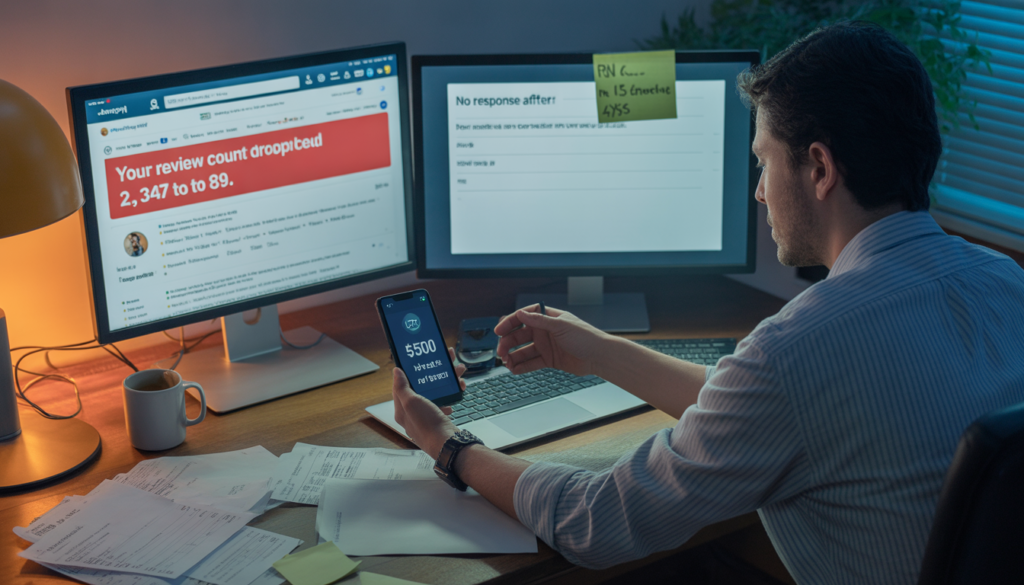
You have 2,300 reviews. A 4.8-star rating. You wake up one morning, and they’re gone. Not reduced. Gone. Your listing looks like it launched yesterday. Your conversion rate tanks. Your ad spend stays the same, but your sales drop 60%. Amazon’s support team sends you a form letter. No explanation. No appeal. No human. And you realize: you never owned those reviews. You rented them. Here’s why that’s a $2 million mistake — and how to build a reputation nobody can take from you.
I’ve spent years helping sellers navigate Amazon’s review system, and I’ve seen the same pattern repeat over and over. A seller builds a thriving business on the back of hundreds or thousands of positive ratings. Then, without warning, the rug gets pulled. Sometimes it’s a competitor leaving a wave of one-star reviews. Sometimes it’s Amazon’s AI sweeping away years of hard work in a single night. Sometimes it’s an extortionist demanding money to remove a negative review. And sometimes, it’s a genuine mistake — a false positive that takes months to overturn.
The common thread? The seller has no control, no recourse, and no backup plan. Their entire business is built on borrowed land.
This isn’t a fringe problem. In 2025 alone, Amazon blocked 2.75 billion suspected bad listings and banned 19.4 million counterfeit units. And the crackdown on reviews has intensified dramatically. In the first week of 2026, sellers in popular categories like wigs and electronics saw their review counts drop from 92 to 9 or even zero overnight. A product at the top of the new releases list was left with just a single Verified Purchase review. One seller’s rating plummeted from 4.8 to 4.0 after a competitor orchestrated a coordinated attack. Another had their account suspended for 594 days — nearly two years — because of an automated review loop that no human could break. And some sellers have been held hostage by extortionists who buy their products, threaten to leave one-star feedback unless paid, and then follow through when ignored.
Welcome to the reality of selling on Amazon. Your reputation is not your own. And if you don’t build a backup, you’re one AI update away from bankruptcy.
Part 1: The Amazon Review System — A House of Cards
Let’s start with a simple truth: Amazon’s review system is not designed to protect sellers. It’s designed to protect Amazon.
The platform has a zero-tolerance policy against any form of review manipulation — incentivized reviews, fake reviews, attempts to filter feedback, or offering compensation in exchange for positive reviews. And in theory, that’s good for everyone. In practice, the enforcement is inconsistent, opaque, and often automated.
Here’s how Amazon removes reviews:
| Reason for Removal | How It Works |
|---|---|
| Violation of Community Guidelines | Reviews containing hate speech, promotional content, or off-topic comments |
| Reviewer deletion | The customer removes their own review |
| Product listing correction | Multiple products incorrectly listed as the same product are separated |
| Unusual review behavior | Amazon detects suspicious patterns (same IP, new accounts, high review-to-purchase ratio) |
If your reviews disappear, Amazon will usually tell you that reviews are removed for only these specific reasons. But they won’t tell you which reason applies to your case. And they won’t give you an appeal channel unless you know exactly where to look.
This opacity is by design. Amazon’s AI now analyzes not just review content but also the source of the review, the behavior of the buyer account, and the overall review curve. If the algorithm detects a sudden spike in reviews from the same region, or a new account leaving glowing reviews for a single product, those reviews are gone — regardless of whether they’re authentic.
For sellers, this creates a terrifying dynamic: your reputation can be erased by an algorithm that doesn’t understand nuance, and you have no way to fight back except through a labyrinthine appeals process that often ends in automated rejection.
Part 2: The Many Faces of Review Extortion
Scenario 1: The Competitor Attack
This is the most insidious form of review abuse. A competitor — often in China, often selling a knockoff — decides to take you down by flooding your listing with one-star reviews.
One seller reported receiving over 100 one-star reviews during the 2025 Christmas season alone, all from a single competitor. They had hard evidence — screenshots, order IDs, communication records — and Amazon did nothing for two weeks.
Another seller faced a coordinated attack that included extortion and feedback manipulation. The competitor copied their listing, had it removed by Amazon, apologized via email, then threatened to ruin their business. Shortly after, 11 suspicious COD orders appeared on a single ASIN, and seven of them left malicious one-star feedback. The seller provided all evidence to Amazon, including threatening emails and buyer messages. The response? “We have forwarded your case to the Investigating team” — a black hole from which no resolution ever emerges.
Scenario 2: The Buyer Extortionist
This one is even more direct. A buyer places multiple orders — sometimes eight or more — then contacts the seller outside Amazon (via WhatsApp, email, or phone) demanding money in exchange for not leaving negative reviews. They provide order IDs as proof of purchase and threaten a coordinated review bomb if their demands aren’t met.
When the seller reports this to Amazon, they’re told that threats made outside Amazon aren’t their problem. Meanwhile, the buyer continues placing new orders, and the seller can’t cancel them because they’re FBA. The seller is completely exposed, unable to protect themselves from a malicious actor who has weaponized Amazon’s own system against them.
Scenario 3: The AI False Positive
Perhaps the most terrifying scenario is the one where you’ve done nothing wrong at all.
In early 2025, a seller with thousands of legitimate, Verified Purchase reviews saw half of them disappear overnight. Amazon’s response? “Reviews are removed for only these specific reasons. If you believe this was an error, email community-help@amazon.com”. No guarantee of a response. No timeline. No human to talk to.
In 2026, Amazon’s review-cleaning AI became even more aggressive. In a single week, sellers in the wig category saw their review counts drop from 92 to 9 — a 90% reduction. The AI was scanning for “suspicious patterns” like reviews from the same IP address range or new accounts leaving reviews too quickly. Legitimate reviews were caught in the crossfire.
And then there’s the “dead loop” — a seller whose account was suspended in June 2024 and has spent 594 days trying to get it reinstated. They followed Amazon’s instructions to the letter, destroyed their existing inventory, sourced a new product from a major UK wholesaler, and provided all documentation. Every appeal is rejected within hours by an automated system that keeps referencing the old, deleted ASIN instead of the new one. The wholesaler confirms that Amazon has never contacted them for verification. The seller is trapped in a procedural loop with no human oversight.
Part 3: The Real Cost — Beyond the Lost Reviews
Let me put some numbers on this. A seller with 2,300 reviews and a 4.8-star rating might generate $200,000 in monthly revenue. Overnight, if those reviews disappear, here’s what happens:
| Impact Category | Before Review Loss | After Review Loss |
|---|---|---|
| Conversion rate | 12% | 4% |
| Monthly orders | 5,000 | 1,600 |
| Monthly revenue | $200,000 | $64,000 |
| PPC cost (same spend) | $20,000 | $20,000 |
| ACoS (Ad Cost of Sale) | 10% | 31% |
That’s a $136,000 monthly revenue drop — $1.6 million annually — from a single algorithmic decision that you can’t appeal, can’t prevent, and can’t reverse.
And that’s just the direct financial hit. There’s also the time cost: dozens of hours spent writing appeals, opening support tickets, and waiting on hold. The reputational cost: customers who see a low-star product and scroll past. The psychological cost: the sleepless nights, the stress, the feeling of being powerless.
Part 4: The Contrarian Take — When Amazon Reviews Are (Mostly) Safe
I’ll lose some consulting fees here, but honesty matters. If you’re selling low-volume, high-ticket items (like industrial equipment or B2B goods), your review count matters less. If you’re using Amazon Vine, the official review program, those reviews are less likely to be swept up in AI purges. And if you have a well-diversified channel strategy — your own website, email list, social following — losing Amazon reviews hurts, but it doesn’t kill you.
But if you’re a typical D2C brand on Amazon, selling consumer goods in competitive categories? Your reviews are your lifeblood. And they’re not safe.
Part 5: How to Stop Renting Your Reputation
The only way to protect yourself is to build a reputation that you actually own. Here’s how.
Step 1: Capture Reviews on Your Own Site
Every customer who buys from your Amazon listing should be offered an incentive to leave a review on your own website. Not a paid review — that’s against Amazon’s rules — but a simple “register your product for warranty and share your experience” card in the packaging. The QR code leads to a landing page on your WooCommerce store where customers can leave a review that you control.
Step 2: Use Amazon Vine for Compliance
Amazon Vine is the platform’s official, compliant review program. It’s slow, expensive, and has high entry barriers — but the reviews you get through Vine are far less likely to be removed by Amazon’s AI because they’re formally sanctioned. It’s not a complete solution, but it’s part of the mix.
Step 3: Build an Email List
Every customer who registers their product on your site gives you their email address. That’s your insurance policy. If Amazon wipes your reviews tomorrow, you still have a direct line to thousands of happy customers who can leave new reviews on your own platform.
Step 4: Diversify Your Sales Channels
The sellers who survive platform shocks are the ones with multiple revenue streams. If Amazon bans your account or wipes your reviews, you need your own website already generating revenue. We’ve helped dozens of sellers migrate from Amazon to WooCommerce, building a channel they actually own. Our Starter Package ($2,497) gets you a professional store in 10 days. Our Growth Package ($3,997) includes email automation and review migration. Our Premium Package ($7,997) gives you a complete done-for-you operation.
Step 5: Respond to Every Negative Review — Publicly
Even if Amazon won’t remove a fake review, you can respond to it. A professional, empathetic response — “We’re sorry you had this experience. Please contact us at support@yourbrand.comso we can make it right” — signals to future customers that you care about service. It also creates a paper trail that can help with future appeals.
Your Next Move
Amazon’s review system is not your friend. It’s a tool that can be turned against you at any moment — by competitors, by extortionists, or by the platform’s own AI. The only way to protect your reputation is to stop renting it.
Book a free reputation audit. We’ll review your Amazon presence, identify your biggest risks, and show you how to build a review system you actually own — on your own website, with your own customers, beyond Amazon’s reach. No obligation. Just the math.
👉 Book Your Free Consultation →
Related Reading
- Platform Risk is Real: Why Renting Your Infrastructure is a Strategic Failure
- Your Amazon Seller Account Is Not an Asset. Here’s Why That’s Costing You a Fortune.
- Don’t Start an E‑commerce Store Until You Read This Margins Report
- Store Audit & Strategy Session ($197 – credited toward any package)
- Growth Package ($3,997) – For Sellers Ready to Scale