
Published by Bastion Prime | Edited by Heorhi Tratsiak, CEO
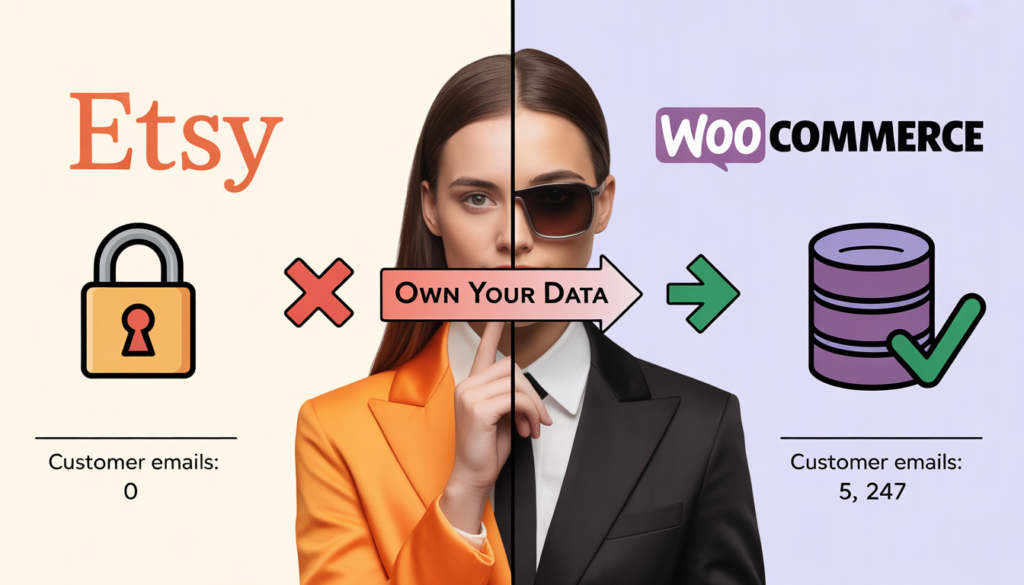
You have 10,000 sales on Etsy. You have zero email addresses. You don’t know who bought what, when, or how often. You can’t send a discount code to your best customers. You can’t ask for a review after six months. You can’t even see which products are bought together. Etsy owns your customer data. You just rent it. Here’s what that really costs — and why WooCommerce puts you back in control.
I talk to Etsy sellers every week. They’re proud of their shops. They have great reviews. Steady sales. A loyal following.
Then I ask a simple question: “How many email subscribers do you have?”
The answer is almost always zero.
Not because they didn’t try. Because Etsy doesn’t let them. The platform hides customer emails behind a privacy wall. You can’t export them. You can’t import them into Klaviyo. You can’t send a “we miss you” message to someone who bought from you three times.
That’s not a marketplace. That’s a blindfold.
Let me show you exactly what data Etsy gives you, what it hides, and why moving to WooCommerce changes everything.
Part 1: What Etsy Actually Lets You See (It’s Not Much)
Etsy’s “customer data” is a joke. Here’s what you get:
- Order details – what they bought, when, how much they paid.
- Shipping address – where to send the product.
- Customer name – first name only, usually.
- A message thread – you can communicate with them through Etsy’s system.
Here’s what you don’t get:
- Email address – you can message them on Etsy, but you can’t take that email off the platform.
- Phone number – unless they provide it for shipping.
- Purchase history across your shop – you can see individual orders, but Etsy won’t show you “this customer has bought from you five times.”
- Browsing behavior – what they looked at, added to cart, or abandoned.
- Lifetime value – you have to calculate it manually by digging through order history.
- Segmentation data – you can’t group customers by “bought in last 30 days” or “spent over $200.”
Etsy gives you just enough data to fulfill orders. Nothing more.
The real cost: You can’t market to your own customers. Every sale is a one‑time transaction. You start from zero every single day.
Related: For a full breakdown of Etsy’s fee structure, read How Much Does Etsy Really Charge Sellers in 2026 – The Full Breakdown.
Part 2: What Etsy Takes That You’ll Never Get Back
Etsy’s data policies aren’t just restrictive. They’re actively harmful to your business.
They Own the Relationship
When a customer buys from you on Etsy, they receive emails from Etsy, not from you. Order confirmations come from transaction@etsy.com. Shipping updates come from Etsy. Review requests come from Etsy.
The customer remembers buying “on Etsy.” Not from your brand. You’re a faceless seller inside a giant mall.
They Control Communication
You can message customers through Etsy’s system. But those messages are filtered. Etsy blocks certain words, flags certain offers, and monitors every conversation.
Want to send a discount code for your own website? Etsy may block it. Want to ask customers to join your email list? That’s against their rules.
They Keep the Data After You Leave
Close your Etsy shop. All those customer emails? Gone. You can’t export them. You can’t take them with you. You built a business on borrowed land, and when you leave, the landowner keeps the crops.
I’ve seen sellers with 50,000 sales close their shops and walk away with nothing but memories. No email list. No repeat buyers. No way to restart.
Related: For a real‑world example of leaving Etsy, read The $3,000 Mistake: Why I Regret Using a Cheap Plugin to Migrate from Etsy to WooCommerce.
Part 3: What WooCommerce Gives You (Full Ownership)
Now let’s talk about the alternative.
When you run your own WooCommerce store, you own everything. Not some things. Everything.
Complete Customer Data
Every customer who creates an account or checks out gives you their email address. That email is yours. Forever. You can export it, import it into any email platform, and send as many messages as you want.
You also get:
- Full name
- Billing address
- Shipping address
- Phone number (if you ask for it)
- Order history (every product they’ve ever bought)
- Customer notes (internal, for your team)
Behavioral Tracking
WooCommerce integrates with Google Analytics, Facebook Pixel, and tools like Klaviyo. You can see:
- Which products customers view
- What they add to cart
- Where they abandon checkout
- Which emails they open
- What they click
You can segment by behavior. “Customers who viewed the blue sweater but didn’t buy.” “Customers who bought coffee beans in the last 30 days.” “Customers who spent over $500.”
Lifetime Value Calculation
WooCommerce stores every order in your database. You can calculate LTV per customer, per product, per channel. You can see which customers are most valuable and market to them differently.
Etsy doesn’t give you any of this. Not even close.
Part 4: The Real Cost of Not Owning Your Data
Let me put numbers on this.
Etsy seller example:
- Monthly revenue: $15,000
- Average order value: $45
- Monthly orders: 333
- Customers per year: 4,000
- Email subscribers: 0
- Repeat purchase rate (estimated from Etsy’s limited data): 8%
Same seller on WooCommerce (after migration):
- Monthly revenue: $15,000 (same products, same prices)
- Average order value: $45
- Monthly orders: 333
- Customers per year: 4,000
- Email subscribers after 6 months (via packing inserts + popups): 1,200
- Repeat purchase rate (from email marketing): 22%
The difference in annual revenue:
On Etsy: 4,000 customers × 8% repeat rate = 320 repeat orders × $45 = $14,400
On WooCommerce: 4,000 customers × 22% repeat rate = 880 repeat orders × $45 = $39,600
That’s an extra $25,000 per year from the same customers. Not from new traffic. From owning your list and being able to email them.
Over five years: $125,000 in additional revenue. From one simple change: owning your customer data.
Related: For a real case study on email list building, read From $0 to 5,000 Email Subscribers in 90 Days After Leaving Amazon. The same principles apply to Etsy.
Part 5: How to Start Owning Your Data (While Still on Etsy)
You don’t have to leave Etsy tomorrow. But you should start collecting data today.
Strategy 1 – Packing Inserts
Every order gets a card: “Register your purchase on our website for a free gift + 15% off your next order.” Use a QR code and a short URL.
You’ll capture 5–15% of your Etsy buyers. Those emails are yours. Forever.
Strategy 2 – Redirect Traffic to Your Site
Use Etsy for discovery, but drive traffic to your own website for repeat purchases. Put your website URL in your shop announcement, your about page, and your social media bios.
Strategy 3 – Build a Landing Page
Create a simple page on your WooCommerce site: “Join our VIP list for exclusive discounts and early access to new products.” Promote it in your Etsy shop, on Instagram, and in your packaging.
Strategy 4 – Run Your Own Ads
Don’t rely on Etsy’s Offsite Ads. Run Google Shopping or Facebook ads to your own website. The traffic is more expensive, but the customer is yours. You get their email. You can market to them again.
Etsy’s Offsite Ads charge you 12% and give you zero data. Your own ads charge you 5–10% and give you everything.
Related: Learn why Etsy’s Offsite Ads are a trap in Why Etsy’s Offsite Ads Fee Is Forcing Sellers to Raise Prices by 12% (And What to Do Instead).
Part 6: The Migration – How to Move Your Data (The Right Way)
When you’re ready to leave Etsy, here’s what you need to migrate.
Products and variations. Use a proper migration plugin like LitExtension or Cart2Cart. They’ll handle your listings, categories, images, and product options. Do not use a cheap $39 plugin – read The $3,000 Mistake to understand why.
Reviews. You can import your Etsy reviews using a plugin like Ryviu or Judge.me. Display them on your WooCommerce site to maintain social proof.
Customer emails. You cannot export emails from Etsy. But you can invite customers to join your list via packing inserts. Start this process months before you migrate.
Order history. Most sellers don’t migrate order history. It’s a lot of data and rarely needed. But if you need it for accounting, export your Etsy CSV files and store them offline.
The right way: Start building your WooCommerce store 2–3 months before you close your Etsy shop. Run both in parallel. Use packing inserts to move customers to your email list. Then gradually shift traffic to your own site.
Part 7: The Contrarian Take – When You Should Stay on Etsy
I’ll lose some consulting fees here, but honesty matters.
Do not leave Etsy if:
- You sell one‑of‑a‑kind vintage items. Your catalog changes too fast to manage two channels.
- You’re under $2,000 per month in revenue. Focus on growing first.
- You don’t have time to manage another channel. Running your own site takes work.
Do leave Etsy if:
- You sell products you can source repeatedly (jewelry, art prints, skincare, candles, apparel).
- You want to own your customer relationships.
- You’re tired of paying 6.5% transaction fees + 3% payment processing + 12% offsite ads.
- You want to build a business you can sell someday. An Etsy shop is not an asset. A WooCommerce store is.
For most established Etsy sellers (over $3,000/month), owning your data is the difference between a hobby and a real business.
Your Next Move
You don’t need to hate Etsy. But you need to stop depending on it.
Start today. Print packing inserts with your website URL. Build a simple landing page. Collect emails. In six months, you’ll have a list of customers who know your brand, not Etsy’s.
When you’re ready to migrate fully, we can help. Our Starter Package ($2,497) moves your products to WooCommerce in 10 days. Our Growth Package ($3,997) adds review import, email automation, and custom design.
Book a free consultation to discuss your Etsy catalog and data strategy.
👉 Book Your Free Consultation →
Related Reading
- How Much Does Etsy Really Charge Sellers in 2026 – The Full Breakdown
- Etsy vs Your Own Website – The Real Cost Comparison Nobody Shows You
- What Happens to Your Etsy Shop When You Open Your Own Store
- The Invisible Wall: How Marketplaces Prevent You from Building Real Brand Loyalty
- Store Audit & Strategy Session ($197 – credited toward any package)