
Published by Bastion Prime
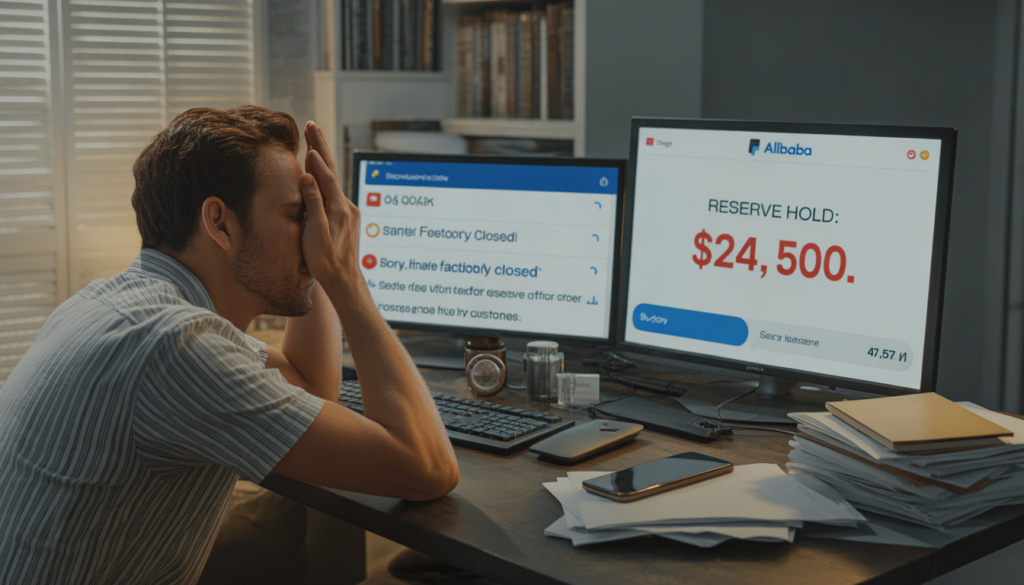
You have a “profitable” dropshipping store. $10k a month. Maybe $20k. You’ve never touched inventory. Your supplier ships directly to customers. You wake up one morning to 47 angry emails: orders from last week haven’t moved. Your supplier’s Alibaba account is suspended. They took your money and disappeared. Your PayPal account is frozen from chargebacks. Your Facebook ad account is banned for “unusual activity.” And you realize: you never had a business. You had a permission slip from a stranger on the other side of the world.
I’ve seen this exact scenario play out more times than I can count. The dropshipping dream sold by YouTube gurus — “no inventory, no shipping, passive income” — is the most dangerous lie in e‑commerce. Not because dropshipping can’t work. It can. But because the people selling the dream omit the one thing that matters: you have zero control over the most critical part of your business.
Your supplier is your lifeline. And most suppliers are one bad batch, one shipping delay, or one Chinese holiday away from destroying everything you built.
This is not a scare story. This is a post‑mortem of dozens of failed dropshipping stores — and a roadmap to turn your fragile operation into a real, resilient brand.
Part 1: The Dropshipping Illusion – What They Don’t Tell You
Let me start with a number that should terrify you.
According to industry data, the average dropshipping store has a customer return rate of 15–25%— not because the products are bad (though many are), but because shipping times average 15–30 days, tracking information is unreliable, and the customer service experience is nonexistent.
Compare that to a standard e‑commerce store with local inventory: return rates average 5–10%, and most of those are genuine defects or sizing issues, not “where’s my order?”
Here’s what the guru doesn’t show you:
| Hidden Cost | Dropshipping Reality | Traditional E‑commerce |
|---|---|---|
| Average shipping time | 15–30 days | 2–5 days |
| Customer service tickets per 100 orders | 25–40 | 5–10 |
| Chargeback rate | 1.5–3% | 0.5–1% |
| Payment reserve hold (PayPal/Stripe) | 20–40% for 90–180 days | 0–10% |
| Supplier dependency risk | Extreme (one supplier = entire business) | Low (you control inventory) |
These numbers aren’t theoretical. They’re the reason payment processors treat dropshipping as a “high‑risk” industry. And high risk means frozen funds, rolling reserves, and sudden account terminations.
Let me give you a real example. A dropshipping store doing $50k/month had their Stripe account frozen after a 2% chargeback spike over two weeks. The trigger? Their supplier shipped defective products during a holiday rush. The store owner couldn’t refund customers because Stripe held $40k in reserves. Customers filed more chargebacks. The death spiral took 11 days from first complaint to permanent ban.
The owner lost their payment processor, their ad accounts (connected to the same Stripe account), and their supplier (who blamed them for the returns). Total loss: $200k+ in revenue, plus two years of work.
This is not an edge case. This is the structural vulnerability of dropshipping.
Part 2: The Five Ways Your Supplier Can Kill Your Business (Overnight)
Let me break down exactly how your business dies — not through competition, not through bad marketing, but through supplier failure.
Failure #1: The Disappearing Act
You’ve been working with a supplier for 18 months. Communication is fine. Orders ship on time. Then one day, their Alibaba store goes dark. Their WhatsApp number stops responding. You later discover they changed their company name to avoid bad reviews and started fresh with a new account.
Your last order of 500 units never shipped. You’ve already collected payment from customers. Now you have to refund $15,000 out of your own pocket — money that was already spent on ads and overhead.
The real cost: Not just the refunds. The reputational damage. The chargebacks. The months of rebuilding supplier relationships.
Failure #2: The Quality Bait‑and‑Switch
Your first few sample orders are perfect. You start scaling. Then the supplier quietly switches to cheaper materials or a lower‑grade factory to increase their margin. You don’t notice until customer complaints start pouring in — “product arrived broken,” “color completely different from photos,” “smells like chemicals.”
By the time you identify the issue, you’ve shipped 2,000 defective units. Your reviews drop from 4.5 to 2.8 stars. Your ad account’s quality score tanks. You spend the next three months fighting returns and rebuilding trust.
The hidden cost: Lost future revenue from customers who will never buy again. Studies show that a single poor delivery experience leads to 52% of customers abandoning a brand permanently.
Failure #3: The Shipping Disaster
Your supplier promises 5–7 day shipping via ePacket. But during peak season (November–January), their logistics partner gets overwhelmed. Orders take 20–30 days. Customers start emailing after day 10. You promise to investigate. Your supplier stops responding. By day 25, you’re processing hundreds of refunds.
Your payment processor flags your account for excessive refunds. Your ad account’s conversion rate drops because angry customers leave bad Facebook comments. Your entire business grinds to a halt during the most profitable quarter of the year.
The math: A store doing $10k/month in November normally makes $30k. With shipping delays, you make $5k after refunds and lose 30% of your customer list forever.
Failure #4: The Intellectual Property Trap
You’re selling a popular product. Your supplier promises it’s “original design.” It’s not. A month later, you receive a cease‑and‑desist from the actual brand owner. Your store gets suspended. Your ad accounts are banned. You lose everything — including the money you spent on branding, photography, and marketing.
Even if you didn’t know, the platform doesn’t care. You’re liable. And the supplier who sold you the counterfeit product? They’ve already moved on to the next sucker.
Failure #5: The Payment Freeze Cascade
This is the most common killer. Your supplier ships late. Customers file chargebacks. Your chargeback rate exceeds 1%. Your payment processor (Stripe, PayPal, Square) places a rolling reserve on your account — holding 20–30% of your payouts for 90–180 days.
Without cash flow, you can’t pay your supplier for the next batch of orders. Your supplier stops shipping. More orders go unfilled. More chargebacks. Your processor terminates your account. You’re blacklisted from opening a new merchant account for years.
This is not a hypothetical. I’ve consulted for three stores in the last year that died exactly this way. All were profitable on paper. All were bankrupt in reality.
Part 3: The Contrarian Opinion – When Dropshipping Actually Makes Sense
I’ll lose some consulting fees here, but honesty matters.
Dropshipping is acceptable if:
- You’re testing a product category with less than $2,000 total budget
- You have a backup supplier already vetted and ready to switch
- You’re not relying on it as your primary income source
- You have cash reserves to cover refunds for 30 days
Dropshipping is a trap if:
- You’ve been doing it for more than 6 months and haven’t moved to holding inventory
- Your monthly revenue exceeds $20,000 but you still don’t own stock
- Your entire business depends on a single supplier
- You’re using AliExpress or similar platforms without a direct relationship
The only rational use of dropshipping is as a validation tool — not a business model. Test a product for 30–60 days. If it sells, order bulk inventory. Switch to a 3PL (third‑party logistics) or your own warehouse. Take control of quality, shipping, and customer experience.
If you treat dropshipping as a permanent solution, you’re not an entrepreneur. You’re a middleman with extra steps — and middlemen get eliminated.
Part 4: The Escape Plan – How to Turn Your Dropshipping Store Into a Real Business
If you’re currently dropshipping and want to survive, here’s your 90‑day roadmap.
Month 1: Audit Your Suppliers
| Supplier | Order Volume | Quality Score (1–10) | Shipping Reliability | Backup Supplier Identified |
|---|---|---|---|---|
| Supplier A | 70% | 8 | 85% | ✅ |
| Supplier B | 20% | 5 | 60% | ❌ |
| Supplier C | 10% | 9 | 95% | ✅ |
Identify your most reliable supplier (highest quality + fastest shipping). Negotiate bulk pricing. Order a test batch of 100–200 units to your own address.
Month 2: Shift to 3PL
Find a third‑party logistics provider in your target market (USA, Europe, etc.). Ship your test batch to their warehouse. Fulfill a small percentage of orders from local stock (10–20%). Monitor customer satisfaction and shipping times.
Month 3: Gradual Transition
Over 30 days, shift 50% of orders to local fulfillment. Keep your best dropshipping supplier as backup. Reduce ad spend on products that can’t be fulfilled locally. Increase prices on locally stocked items to reflect faster shipping.
The result: You now control your supply chain. Shipping times drop from 15–20 days to 2–5 days. Return rates drop by 60%. Customer lifetime value increases by 2–3x. Payment processors stop holding your funds.
Part 5: The Math – Why Owning Inventory Is Cheaper Than You Think
Most dropshippers are terrified of holding inventory. “What if it doesn’t sell?” Fair question. Let me do the math.
| Scenario | Dropshipping (100 orders) | Local Inventory (100 orders) |
|---|---|---|
| Product cost (COGS) | $15/unit = $1,500 | $10/unit (bulk) = $1,000 |
| Shipping cost per order | $8 = $800 | $4 = $400 |
| Customer service hours | 20 hours ($500) | 5 hours ($125) |
| Chargeback rate | 2% = $300 | 0.5% = $75 |
| Total cost for 100 orders | $3,100 | $1,600 |
The inventory scenario saves $1,500 per 100 orders — $15 per order. That’s pure profit improvement.
Now factor in the risk of unsold inventory. Let’s say you order 500 units at $10 each = $5,000 investment. You sell 400 units in 3 months. The remaining 100 units cost you $1,000. But you saved $15 per order on 400 orders = $6,000 in savings. Net gain: $5,000.
Even if you only sell 300 units, you break even. And you still own the remaining stock to liquidate or bundle.
Holding inventory is not risky. It’s the only way to build a real asset.
Your Next Move
Dropshipping is not a business. It’s a lead‑gen tool for your real business. If you’re still relying on AliExpress suppliers and praying they ship on time, you’re one bad week away from disaster.
We’ve helped dozens of dropshippers transition to local fulfillment — with WooCommerce stores, 3PL integrations, and proper inventory management. Our Starter Package ($2,497) gets you a professional store in 10 days. Our Growth Package ($3,997) adds email automation and inventory sync. Our Premium Package ($7,997) includes complete supply chain setup.
Book a free supply chain audit. We’ll review your current suppliers, calculate your hidden costs, and give you a 90‑day roadmap to a real business. No obligation. Just the math.
👉 Book Your Free Consultation →