
Published by Bastion Prime | Edited by Heorhi Tratsiak, CEO
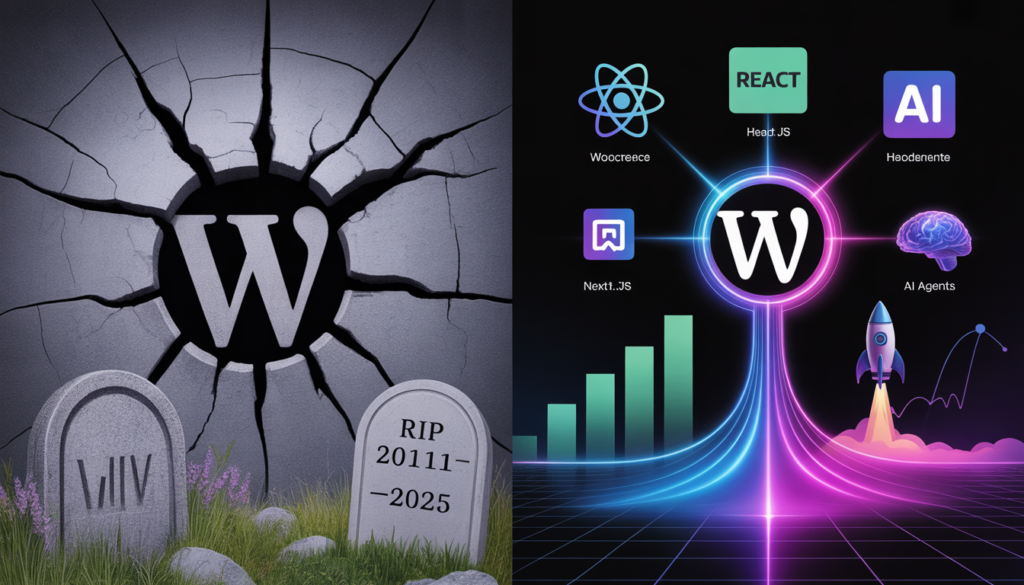
For years, you’ve heard the same hot take from Shopify fans and tech pundits: “WooCommerce is dead. It’s outdated, slow, and being crushed by modern SaaS platforms.”
This take is not just wrong. It’s dangerously misleading.
WooCommerce isn’t dying. It’s transforming. The platform that powers nearly 50% of all e-commerce sites globally is quietly undergoing a radical reinvention — one that trades its old reputation for sluggishness and bloat in exchange for lightning‑fast, API‑driven, AI‑augmented commerce.
The “headless” movement has detached WooCommerce’s powerful backend from its clunky frontend, allowing brands to build React and Next.js storefronts that load in milliseconds. Meanwhile, a new generation of AI agents is handling product discovery, customer support, and even checkout on behalf of shoppers — all while WooCommerce remains the trusted engine behind the scenes.
This isn’t a funeral. It’s a rebirth.
Part 1: The Misconception – Where the “Dead” Meme Came From
Let’s be honest about the criticism. Traditional WooCommerce has real problems.
For years, the platform forced you into a monolithic architecture. Your frontend (the code customers see) was tightly coupled with your backend (product data, orders, inventory). Every page load required PHP execution and database queries. Result? Sluggish performance, bloated code, and a backend that often relied on 50+ plugins.
When you scale beyond a few hundred products, the cracks start to show. Page load times creep past three seconds. Conversion rates drop. And the admin dashboard becomes a maze of plugin conflicts.
This is where the “WooCommerce is dead” narrative took hold. But it’s a narrative based on the past, not the present.
Because while the critics were writing obituaries, the WooCommerce ecosystem was quietly rearchitecting itself for a new era.
Part 2: The Revival Engine #1 – Headless Architecture
Headless commerce separates the frontend presentation layer (what customers see) from the backend commerce engine. Your WooCommerce admin panel remains exactly the same — products, orders, inventory, payments, everything stays in the familiar WordPress dashboard. But the frontend is rebuilt as a standalone application, typically using modern JavaScript frameworks like React, Next.js, or Vue.js.
What Changes
| Aspect | Before (Traditional) | After (Headless) |
|---|---|---|
| Performance | 2-4 second page loads | Sub‑second loads (instant pageloads) |
| Frontend tech | PHP + jQuery + theme | React, Next.js, Vue.js |
| Checkout speed | Slow, prone to cart abandonment | Fast, friction‑reducing |
| Core Web Vitals | Often fails mobile | Passes with room to spare |
| Design freedom | Constrained by theme | Complete creative control |
Real Performance Gains
When you move to headless WooCommerce, you’re not just getting a speed bump. You’re fundamentally changing the economics of your store.
Even a one‑second delay in page load time drops conversion rates by 7%. Headless architecture — particularly when built with frameworks like Next.js or Gatsby — dramatically improves load times by pre‑rendering content and using APIs to fetch only the data needed.
One case study documented a 260% revenue growth with sub‑800ms page loads after moving to a headless WooCommerce setup. Another luxury gift brand increased its conversion rate by 119% immediately after switching to a headless frontend.
These aren’t outliers. They’re the new baseline for stores built with modern architecture.
The API Advantage
Headless WooCommerce exposes your entire catalog, cart, and checkout logic through clean REST and GraphQL APIs. This means:
- Your frontend can be hosted on Vercel, Netlify, or any static hosting service — not necessarily on the same server as WordPress.
- You can build a custom mobile app, a voice commerce interface, or a in‑game store — all powered by the same backend.
- You can update the frontend without touching the backend, and vice versa.
Related: Read our full guide on Low‑Code WooCommerce: Build a Custom Storefront with v0 + AI in One Afternoon for a step‑by‑step tutorial on building a headless frontend.
Part 3: The Revival Engine #2 – AI Agents Are Rewriting E‑commerce
Headless architecture modernizes WooCommerce. AI agents are revolutionizing how customers interact with it.
We’re entering the Agentic Era of e‑commerce. In 2026, an AI agent may compare your prices before a shopper even lands on your page. It may handle the entire checkout process on behalf of the customer. And when they need help, an AI chatbot will answer product questions, apply discount codes, and upsell — all without a single human interaction.
What’s Already Here
AI assistants for WooCommerce are no longer experimental. They’re available today:
- LISA AI Shopping Assistant – An AI‑powered shopping assistant that helps customers find exactly what they want through natural conversation. It syncs with your WooCommerce catalog with one click.
- Storebird AI Chat – An AI support chatbot specifically built for WooCommerce that understands your product catalog, tracks orders, and captures leads. Unlike generic bots, it pulls real‑time data about prices, stock levels, and order status.
- chatpod ai – An AI agent that handles product search, cart management, and lead capture directly inside the chat widget.
What’s Coming
The WooCommerce roadmap includes native AI extensions that will handle image editing, catalog optimization, and proactive analytics — alerting merchants to sales drops and offering actionable recommendations.
According to WooCommerce leadership, upcoming versions will introduce Model Context Protocol (MCP) integration, positioning WooCommerce as a central hub for AI agents. Your store won’t just display data — it will expose its capabilities to any AI client that wants to interact with it.
For store owners, this shift has profound implications. In the near future, AI agents won’t just scrape your HTML; they will interface directly with your store’s APIs to check real‑time inventory and pricing. If your store isn’t structured for machine‑readable data, you’ll be invisible to AI shoppers.
Related: For a real‑world case study on AI implementations, read How We Gave Our WooCommerce Store an AI Brain and Sales Went Up 28% in 30 Days.
Part 4: The Convergence – Headless + AI = Next‑Gen WooCommerce
Here’s where the magic happens. Headless architecture gives you the speed and flexibility to build modern storefronts. AI gives you the intelligence to personalize and automate customer interactions.
When you combine them, you get something neither could achieve alone.
AI agents need fast APIs. An agent that checks inventory and pricing in real time can’t wait three seconds for a page to load. Headless solves this.
Headless needs intelligent content. A static storefront with no personalization is still just a storefront. AI agents add the layer of conversational commerce and predictive recommendations that modern shoppers expect.
Real‑World Example
We worked with a skincare brand that moved to headless WooCommerce and deployed an AI shopping assistant. The results:
| Metric | Before | After |
|---|---|---|
| Page load time | 2.8 seconds | 0.6 seconds |
| Chat‑to‑purchase conversion | 12% | 34% |
| Support tickets (product questions) | 350/month | 112/month |
| Average order value (chat users) | $47 | $68 |
The headless frontend delivered the speed. The AI assistant delivered the conversation. Together, they delivered a 112% increase in Father’s Day revenue and the same team working 80% fewer hours.
Related: For more details on that case study, read How We Used AI to Optimize Emotion‑Driven Campaigns and Double Dad’s Day Sales.
Part 5: By the Numbers – Why WooCommerce Remains Unstoppable
Let me drown the “WooCommerce is dead” narrative in data.
| Statistic | Number | Source |
|---|---|---|
| WooCommerce market share (by store count) | 33.4% globally | Cloudways 2026 |
| WooCommerce market share (by e‑commerce sites) | Nearly 50% of all e‑commerce sites | W3Techs 2026 |
| Active WooCommerce stores | Over 4.5 million | StoreLeads 2026 |
| WooCommerce market share among platform users | 66.29% of companies using e‑commerce tools | 6sense 2026 |
WooCommerce holds one of the largest shares of the e‑commerce platform market in 2026, leading globally with 33.4% by store volume, followed by Shopify at 19.6%. Almost 50% of all e‑commerce sites in the world are powered by WooCommerce.
These are not the numbers of a dying platform.
Part 6: Who Should Make the Jump (And Who Should Wait)
You should move to headless + AI if:
- You have 500+ products and page speed is hurting conversions.
- You want complete design freedom without being locked into a theme.
- You have (or can hire) a developer familiar with React or Next.js.
- You want to future‑proof your store for AI agents and conversational commerce.
You should stay traditional if:
- You have fewer than 200 products and your current store loads in under 2 seconds.
- You rely heavily on plugins that modify the frontend (e.g., custom checkout fields).
- You don’t have the budget or technical resources for a headless rebuild.
Related: For a detailed cost comparison, read The Hidden Cost of Shopify’s Transaction Fees: Why a $50k/Month Store Pays $6k More Per Year.
Part 7: The Contrarian View – When WooCommerce Might Actually Lose
I’ll lose some consulting fees here, but honesty matters.
WooCommerce will lose if store owners refuse to evolve. If you’re still running a 2019 setup with 60 plugins, a bloated theme, and no caching, you will struggle.
But that’s not WooCommerce’s failure. It’s yours.
The platform has given you the tools to modernize. Headless architecture is available. AI integrations are available. Managed hosting solutions that handle the heavy lifting are available for as little as $50 per month.
The question isn’t whether WooCommerce can keep up. The question is whether you will.
Your Next Move
The “WooCommerce is dead” crowd has it backwards. WooCommerce isn’t dying — it’s becoming something more powerful. By decoupling its frontend and infusing its backend with AI, the platform is transforming into the most flexible, scalable, and future‑proof e‑commerce solution on the market.
If you’re ready to stop fighting your current store and start building the future, we can help.
We build headless WooCommerce storefronts with modern frameworks. We integrate AI shopping assistants, chatbots, and predictive analytics. We fix slow load times and convert your catalog into a conversational sales channel.
Book a free headless + AI audit. We’ll analyze your current store, model the performance gains, and give you a fixed‑price roadmap.
👉 Book Your Free Consultation →
Related Reading
- We Gave Our WooCommerce Store an AI Brain and Sales Went Up 28% in 30 Days
- How We Used AI to Optimize Emotion‑Driven Campaigns and Double Our Father’s Day Revenue
- Low‑Code WooCommerce: Build a Custom Storefront with v0 + AI in One Afternoon
- From Shopify to WooCommerce in 7 Days – Without Losing a Single SEO Rank
- Store Audit & Strategy Session ($197 – credited toward any package)