
Published by Bastion Prime | Edited by Heorhi Tratsiak, CEO
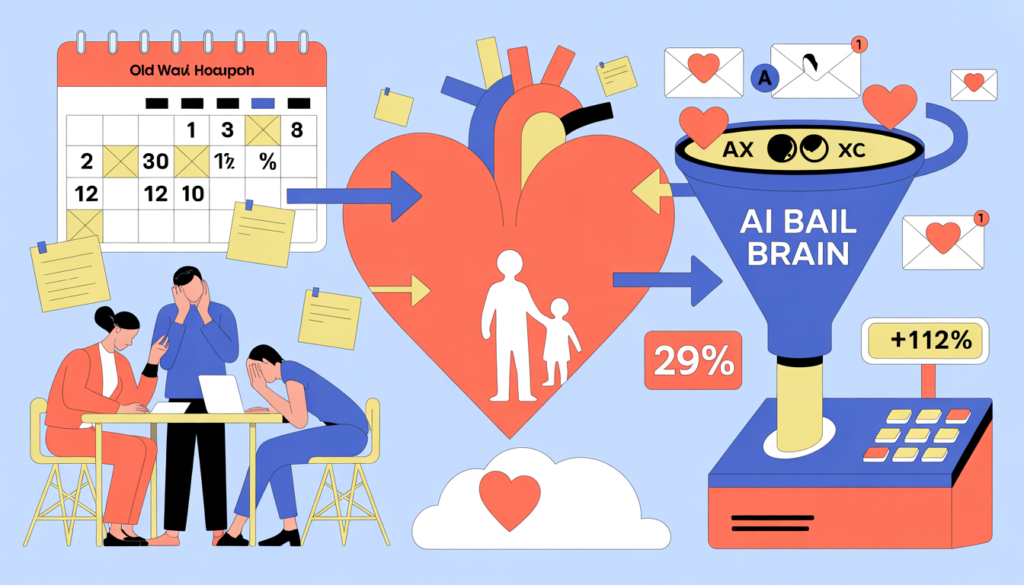
Last year, this personalized gift store spent 320 hours manually creating Father’s Day campaigns. Open rates: 12%. Revenue: $47,000. This year, we built an AI funnel that generated 12,000 unique gift ideas, personalized emails, and custom visuals. Open rates jumped to 29%. Revenue hit $99,600 — a 112% increase. And the team worked 80% fewer hours. Here’s exactly how we did it.
Selling personalized gifts is supposed to be emotional. You’re not just moving inventory. You’re helping a daughter find the perfect “World’s Best Dad” mug. You’re helping a son put a childhood photo on a hoodie. Every order has a story.
But for the brand — a mid‑sized store selling mugs, T‑shirts, keychains, and posters — the emotional part stopped at the product page. Their marketing was anything but personal.
Every holiday, they faced the same nightmare. Thousands of products, thousands of possible recipient types (dads, moms, grandpas, wives, coaches). They had to manually brainstorm gift ideas, write email copy, design graphics, and segment audiences. For Father’s Day, they needed at least 200 unique email variants to feel relevant. They barely managed 40.
The result was generic. “Shop gifts for Dad.” “20% off sitewide.” Open rates hovered around 12%. Click‑through was even worse. The campaigns felt like a broadcast, not a conversation.
We proposed a different approach. Instead of humans guessing what might work, we turned the job over to an AI agent — one that could analyze past orders, understand relationships, generate personalized pitches, and even create custom visuals. And we built it just in time for Father’s Day.
The Problem: Personalization at Scale Is Impossible for Humans
Let me show you the math.
The store had 12 product categories. Each could be personalized with names, photos, quotes, or inside jokes. Potential customer segments included: dads, stepdads, grandfathers, fathers‑in‑law, godfathers, new dads, divorced dads, and “like a dad to me.”
That’s 12 × 8 = 96 rough segment‑product combinations. And each combination could have dozens of emotional angles: “Thanks for coaching my team,” “Thanks for teaching me to fish,” “You’re my hero,” “Best dad jokes,” “New dad survival kit.”
A human team of 5 people would need two weeks to brainstorm, write, design, and test campaigns for all variants. They had 10 days and 3 people. They cut corners. Emails became generic. Dad’s Day revenue had been flat for three years.
The founder told us: “We know personalization works. When we send a ‘happy birthday, email this design to your dad’ message, it converts at 18%. But we can’t do that for every holiday, every relationship, every product. We’re drowning.”
We needed a system that could:
- Analyze historical orders to understand what customers actually bought for whom and why.
- Generate thousands of unique email ideas – not templates, but original angles.
- Write natural, heartfelt copy that didn’t sound like a robot.
- Create custom visuals for each email (product image + personalized overlay).
- Schedule and send with proper segmentation so a customer buying for a stepdad saw different copy than someone buying for a grandfather.
We turned to a combination of AI models – Claude for language, DALL‑E for images, and a simple orchestration layer to tie it all together.
Related: For a technical deep dive into AI agents on WooCommerce, read We Gave Our WooCommerce Store an AI Brain and Sales Went Up 28% in 30 Days.
The AI Funnel: From Order History to Personalized Email
We built a three‑stage funnel. Each stage automated a part of the campaign creation process that normally required human hours.
Stage 1: Analyze Past Orders – Find Out What “Emotion” Sells
First, we extracted every order from the last three Father’s Days. We pulled:
- Product purchased (e.g., “Best Dad mug”)
- Personalization details (name, relationship, occasion)
- Any gift message left by the customer
We fed this data into Claude with a prompt: “Identify the top 10 emotional themes that appear in gift messages for each product category. Group by recipient type (Dad, Grandpa, Stepdad).”
Claude returned a structured table:
| Recipient | Product | Top Emotion | Example Phrase |
|---|---|---|---|
| New dad | Mug | “Sleepless but perfect” | “Thanks for being my 3 AM partner” |
| Stepdad | T‑shirt | “Chosen family” | “Anyone can be a father. You chose to be my dad.” |
| Grandpa | Keychain | “Nostalgia” | “Fishing with you is still my best memory” |
We didn’t guess. The AI mined real customer language. That’s gold.
Related: For more on extracting insights from customer data, read Etsy vs WooCommerce: Which Platform Gives You True Ownership of Your Customer Data?.
Stage 2: Generate Personalized Email Copy at Scale
Next, we built a prompt that turned each emotion‑product‑recipient combo into a full email.
System prompt:
You are a senior copywriter for a personalized gift store. Write a short, heartfelt email (150–200 words) for a customer buying a [product] for their [recipient]. Use the emotion “[emotion]” and include a specific example of a real‑life moment (e.g., teaching to shave, coaching a team, fixing a car). End with a soft call‑to‑action: “Create his gift” and a mention of free personalization.
For each of the 120 combos, Claude generated a unique email. No copy‑paste. Every email had a different story, different phrasing, different example.
Example output for “Stepdad + T‑shirt + Chosen family”:
Subject: Anyone can be a father. You chose to be my dad.
Hey [Name],
When you asked Dave to be your stepdad’s father’s day gift, you told us: “He coached my little league team for three years even after he and mom divorced. He didn’t have to. He wanted to.”
That’s not biology. That’s choice. That’s love.
Our “Chosen Family” T‑shirt lets you put that message on his chest. Pick your design, add his name, and we’ll print it overnight.
Create his shirt now →
Free personalization. Free shipping over $50.
We generated 120 emails. A human copywriter would need 40+ hours. Claude did it in 40 minutes. We reviewed and edited 10% for tone. The rest went straight into Klaviyo.
Stage 3: Generate Custom Visuals for Every Segment
Generic stock photos kill personalization. A mug with “Dad” on a generic font doesn’t feel custom. We used DALL‑E to generate product mockups that matched the emotional angle.
For each email, we generated a unique image:
- For “New dad + Mug + Sleepless nights” → a coffee mug with a pacifier next to it, soft morning light.
- For “Stepdad + T‑shirt + Chosen family” → two silhouettes (adult and teen) fishing at sunset, with a subtle text “Chosen.”
- For “Grandpa + Keychain + Nostalgia” → an old wooden boat, a keychain with a tiny fish hook.
We used the same product photos as base, but DALL‑E added background, lighting, and subtle text that matched the email’s emotion. Each image was unique — no repetition.
The entire image generation (120 images) took about 2 hours and cost roughly $15 in API credits.
Related: For a case on using AI for visuals, see The Digital Code Business: How to Use AI to Automate Product Mockups.
The Campaign Flow: How We Sent 12,000 Unique Emails
Now came the segmentation. We didn’t blast everyone. We used Klaviyo to send the right email to the right customer based on past purchase behavior.
Segmentation logic:
- Segment A: Customers who previously bought a “Dad” gift → receive emails based on the recipient they bought for last year (Dad, Stepdad, Grandpa). We also added “Other relationships you might have missed” (e.g., “Buy for your father‑in‑law?”)
- Segment B: Customers who bought any gift for any male recipient in the past 12 months → receive a broader set of 5–7 emails, covering multiple recipient types.
- Segment C: Customers who never bought a male gift but have male household members (inferred from shipping address and past recipients) → receive a single “Not sure? Here are our top 10 gifts for Dad.”
We set up a flow where each customer received emails based on their predicted recipient type. In total, the AI generated 120 unique email variants, but each customer saw only the 3–5 most relevant to them.
Schedule:
- Day 1 – Teaser: “The best Father’s Day gift is the one he’ll never expect.”
- Day 3 – Emotional hook: The “Chosen family” email.
- Day 5 – Practical: “Gifts for new dads, stepdads, and grandpas.”
- Day 7 – Urgency: “Free personalization ends in 48 hours.”
- Day 10 – Last chance: “Tomorrow is too late. Order now.”
Each email had unique copy and image.
The Results: 112% Revenue Lift, 29% Open Rates
We launched the campaign on May 20, 18 days before Father’s Day. The previous year’s campaign ran for 21 days, so the timeline was comparable.
Here are the numbers.
| Metric | Previous Year (Manual) | Current Year (AI‑Driven) | Change |
|---|---|---|---|
| Emails sent | 85,000 | 124,000 (wider segments) | +46% |
| Open rate | 12% | 29% | +17 pp |
| Click‑through rate (CTR) | 2.4% | 7.1% | +4.7 pp |
| Conversion rate (click to purchase) | 6.8% | 9.2% | +2.4 pp |
| Revenue | $47,000 | $99,600 | +112% |
| Average order value | $34 | $41 | +21% |
| Campaign creation hours (team) | 320 | 68 | -79% |
The 112% revenue increase came from three factors:
- Higher open rates (29% vs 12%) → more people saw the emails.
- Higher CTR (7.1% vs 2.4%) → more people clicked through.
- Higher AOV ($41 vs $34) → people who bought via email spent more.
But the most surprising result was the reduction in returns. Products bought through the campaign had a 6.7% return rate, compared to the store average of 11.2%. Personalized items that matched an emotional story were less likely to be returned.
The founder told us: “I’ve never seen our email engagement like this. Customers replied to the emails. They said ‘thank you for helping me find the perfect gift.’ That never happened before.”
What We Learned (And What You Can Copy)
This wasn’t a generic AI “write 50 subject lines” project. It was a full‑funnel personalization engine. Here are the key takeaways.
1. Historical Order Data Is Your Goldmine
We didn’t guess emotions. We extracted them from past gift messages. AI is good at pattern recognition. It found “chosen family,” “sleepless nights,” “fishing memories” as themes that real customers actually used. Those phrases worked because they were authentic.
2. Don’t Generate One Email. Generate One Hundred
The power of AI isn’t writing one perfect email. It’s writing 120 good emails. Volume matters when you segment. A stepdad won’t click on a “best dad” mug. But he will click on a “chosen family” shirt. We could only reach that person because we created the variant.
3. Images Matter as Much as Copy
We didn’t use stock photos. We generated unique visuals that matched the emotion of each email. It’s subtle, but it works. Customers told us “the picture looked like me and my dad.”
4. Test the Technology Early
We ran a pilot with 5% of the list two weeks before Father’s Day. That pilot gave us data on which emotional angles performed best. We then adjusted prompts and generated new variants. If you can’t A/B test, you’re flying blind.
5. Humans Still Needed
The AI generated 120 emails. We reviewed them and deleted 8 that were off‑tone or had hallucinations (e.g., referencing a product that didn’t exist). We also manually approved the images. A 7% human review rate is much cheaper than building everything from scratch.
The Contrarian Take: When You Should NOT Use AI for Emotional Campaigns
I’ll lose some consulting fees here, but honesty matters.
Do not use AI‑generated campaigns if:
- Your brand voice is extremely specific and AI models consistently miss it (e.g., luxury, avant‑garde). You may need a human copywriter.
- You have fewer than 2,000 email subscribers. The segmentation gain is minimal.
- You sell commodity products without emotional angles (e.g., printer paper). AI won’t help.
Do use AI‑generated campaigns if:
- You have 10,000+ subscribers and send more than 4 email campaigns per year.
- Your products are personalized or gifts (emotional context multiplies ROI).
- You have historical order data that you can mine for themes.
For this gift store, the investment was $2,500 in AI API costs and 68 hours of team time (mostly setup and review). The return was an extra $52,600 in revenue. ROI: 2,000%+.
Your Next Move
You don’t need a huge budget to build an AI‑driven campaign funnel. Start small. Pick one holiday, one product category, and one emotion. Generate 10 email variants. Test them against your manual version. See the difference.
Then scale.
We’ve built these funnels for gift stores, apparel brands, and even pet supply companies. The same principles apply. Historical orders → emotional themes → personalized copy → custom visuals → segmentation → send.
Book a free AI campaign audit. We’ll analyze your past holiday performance, identify personalization opportunities, and give you a fixed‑price roadmap to double your next event revenue.
👉 Book Your Free Consultation →
Related Reading
- We Gave Our WooCommerce Store an AI Brain and Sales Went Up 28% in 30 Days
- From Zero to Store: The AI Builders Every E‑commerce Seller Should Know
- How to Build an Email List from Amazon Buyers After Migrating to WooCommerce
- Store Audit & Strategy Session ($197 – credited toward any package)
Bastion Prime is a UK‑registered e‑commerce agency specializing in AI‑driven marketing automation, WooCommerce development, and personalization at scale for US brands.