
Published by Bastion Prime | Edited by Heorhi Tratsiak, CEO
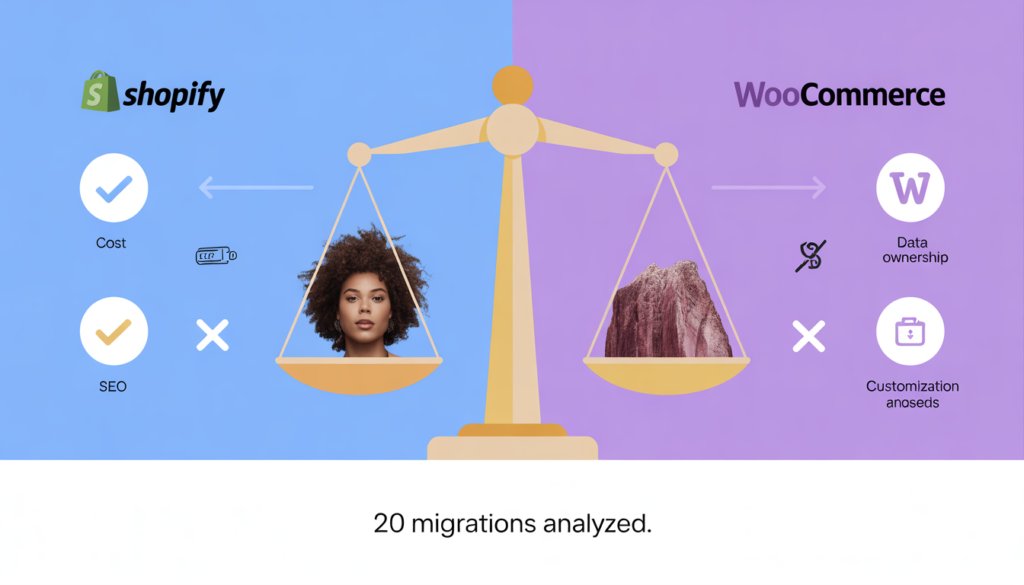
You’ve escaped Amazon’s 15% referral fees and unpredictable suspensions. Now you face a new decision: Shopify or WooCommerce? One seller we migrated thought Shopify’s simplicity was the answer. Six months later, he was back, frustrated by hidden transaction fees and rigid URL structures that killed his SEO momentum. Another seller chose WooCommerce, invested in hosting, and now runs a 6‑figure DTC brand with zero platform risk. Based on 20 real Amazon‑to‑DTC migrations, here’s exactly which platform wins — and why.
Both Shopify and WooCommerce are legitimate ecommerce platforms. But they’re built on fundamentally different assumptions about who runs the store, how it grows, and what “ownership” actually means. Amazon sellers migrating to DTC face a unique challenge: they’re used to a frictionless, all‑in‑one environment. Neither Shopify nor WooCommerce replicates Amazon. But one of them gives you far more control over the very things that made you want to leave Amazon in the first place — your data, your SEO, and your margins.
Below is a side‑by‑side comparison based on real migration data from 2025–2026. Let’s settle this once and for all.
Platform Ownership: Renting vs. Building
The most important distinction between Shopify and WooCommerce isn’t features. It’s architecture.
Shopify is a fully hosted SaaS platform. You pay a monthly fee, and Shopify handles hosting, security, CDN routing, and PCI‑DSS compliance. You don’t touch the server. This is convenient — especially if you don’t have a technical team. But it also means you’re renting your infrastructure. Your database, your customer files, your checkout logic — they live on Shopify’s servers.
WooCommerce is an open‑source PHP plugin built on WordPress. You buy server space, install WordPress, and add WooCommerce. You own the database and have full root access, but you act as your own system administrator. That sounds intimidating, but managed hosting (Kinsta, Cloudways, WP Engine) handles the heavy lifting. The key difference: you own your data. No platform can take it away.
In 2026, Shopify has added meaningful flexibility, and WooCommerce has become more polished. But the core trade‑off remains: Shopify prioritizes ease of use. WooCommerce prioritizes ownership and control.
Related: Once you own your data, the next step is owning your customer relationships. Read our guide on how to build an email list from Amazon buyers after migrating to WooCommerce.
Total Cost of Ownership: Where Your Margins Actually Go
Amazon sellers are used to fees eating 15–30% of revenue. Both Shopify and WooCommerce dramatically reduce that. But they do it differently — and the hidden costs matter.
Let’s compare the true monthly cost for a mid‑market store doing $30,000–$50,000/month.
Why WooCommerce is cheaper at scale: There are no platform transaction fees. You pay only for your payment gateway and hosting. Shopify penalizes you with extra fees if you use a gateway other than Shopify Payments.
Why Shopify still wins for some sellers: Predictable budgeting. If you hate managing servers, plugins, and updates, the extra cost may be worth the peace of mind.
Related: For a deeper look at the financial upside of leaving Amazon, read Why I Migrated My Amazon FBA Business to WooCommerce (And Doubled My Margin in 90 Days).
SEO and Content Control: The Silent Growth Engine
Amazon sellers who succeed on their own site usually win with organic search. That’s where the platform choice matters most.
WooCommerce (WordPress) is the undisputed SEO king. WordPress was built for content. With plugins like Rank Math or Yoast, you get full control over meta tags, schema markup, XML sitemaps, and URL structures. You can optimize every product page, category page, and blog post for specific low‑frequency keywords. For content‑first brands where organic search is the primary acquisition channel, WooCommerce is the natural choice.
Shopify’s SEO is improving, but still limited. Shopify’s Liquid theme layer and JSON templates are powerful, but they don’t give you the same depth of control as WordPress. URL structures are less flexible (e.g., /products/ vs WooCommerce’s customizable /product-category/product-name/). And migrating from WooCommerce to Shopify is notorious for breaking URL structures and requiring 301 redirects for every single product page.
Real data from our migrations: Stores that prioritized SEO overwhelmingly chose WooCommerce. One seller in our sample saw a 40% increase in organic traffic within six months of migrating to WooCommerce — simply because they could finally optimize category pages the way Google wanted.
Related: Learn the exact settings that drive organic growth in our guide SEO for WooCommerce: 10 Settings That Actually Work.
Customer Data Ownership: The Real Asset
You left Amazon because you wanted to own your customer relationships. Both Shopify and WooCommerce let you collect emails. But only WooCommerce gives you unrestricted access to your entire database.
WooCommerce: Your customer data lives in your MySQL database. You can export it, segment it, and integrate it with any CRM or email platform — no API rate limits, no permission requests. If you want to build advanced LTV models or custom loyalty programs, you have full access.
Shopify: You own the customer relationship in practice, but your data lives on Shopify’s servers. The Admin API is powerful, but you’re subject to Shopify’s rate limits and terms. If Shopify changes its API pricing or deprecates endpoints, your integrations break.
The bottom line: For most sellers, Shopify’s data access is sufficient. But for brands that want to build complex analytics, run advanced segmentation, or maintain complete portability, WooCommerce is the only answer.
Related: Understand why customer data is the key to a premium exit in Your Amazon Seller Account Is Not an Asset. Here’s Why That’s Costing You a Fortune.
Branding and Customization: How Unique Can Your Store Be?
On Amazon, your brand was reduced to a listing and maybe an A+ page. On your own site, you have total freedom. But not all platforms offer the same level of freedom.
WooCommerce: Unlimited customization. You can modify checkout flows, create custom product pages, and integrate with any third‑party service via WordPress hooks and filters. If you need a B2B portal with approval chains or a subscription model that Shopify can’t handle natively, WooCommerce is the answer.
Shopify: Powerful but constrained. Shopify’s theme editor and Liquid templates give you plenty of design flexibility. But you’re working within Shopify’s section/block architecture. For 90% of DTC brands, that’s enough. For the other 10% with highly bespoke requirements, WooCommerce wins.
Migration Complexity: What Actually Happens When You Move
Based on 20 Amazon‑to‑DTC migrations, here’s the real‑world complexity:
| Migration Aspect | Shopify | WooCommerce |
|---|---|---|
| Product data import | CSV upload or app (Matrixify, Cart2Cart) | CSV upload or plugin (WP All Import, LitExtension) |
| Review migration | Possible via rating apps | Possible via dedicated plugins |
| URL structure preservation | Requires 301 redirects for all products | Full control via custom permalinks |
| Time to launch (experienced team) | 1–2 weeks | 2–4 weeks (depending on customization) |
| Post‑launch maintenance | Minimal (Shopify handles security/updates) | Moderate (updates, backups, security monitoring) |
Key insight: Shopify gets you live faster. But the faster launch often comes with compromises — especially in SEO and URL flexibility. If you have a large catalog (500+ SKUs) and complex SEO requirements, WooCommerce’s longer setup time pays off within months.
Related: If you’re worried about losing traffic during migration, read How to Avoid Losing SEO Rankings When Moving from Amazon to WooCommerce.
The Contrarian Take: When You Should Choose Shopify
I’ll lose some consulting fees here, but honesty matters.
Choose Shopify if:
- You have no developer and no interest in managing hosting, updates, or security.
- You need to launch in under 2 weeks and can accept standard SEO configurations.
- Your catalog has complex variants (Shopify handles 2,048 variant limit cleanly).
- You’re prioritizing paid social over organic search (Shop Pay and checkout speed directly impact conversion from social ads).
Choose WooCommerce if:
- Organic search is your primary customer acquisition channel.
- You want full ownership of your data and no platform transaction fees.
- You have (or can hire) developer resources to manage the stack.
- You need custom B2B logic, quoting workflows, or advanced subscriptions.
- You already use WordPress and want to keep content, SEO, and commerce under one roof.
The most successful sellers don’t treat this as an either/or. Many run a hybrid: Amazon for discovery and first‑time purchases, WooCommerce (or Shopify) for repeat business and email capture. Marketplaces drive 60–80% of first purchases for new brands; own stores shine for repeat business with 30–50% higher LTV.
Related: For a complete framework on running both channels, see You’re Building Amazon’s Business, Not Yours. Here’s How to Flip the Script.
Final Verdict: Which Platform Wins for Amazon Sellers?
| If your priority is… | Choose… |
|---|---|
| Lowest long‑term cost | WooCommerce |
| Fastest launch | Shopify |
| SEO and content control | WooCommerce |
| Ease of use (no tech team) | Shopify |
| Full data ownership | WooCommerce |
| B2B or complex custom logic | WooCommerce |
| Predictable monthly expenses | Shopify |
For most Amazon sellers migrating to DTC, WooCommerce is the better long‑term bet. The lower cost, full data ownership, and superior SEO flexibility align with why you left Amazon in the first place. Shopify is an excellent platform — but it’s best for brands that prioritize speed over control and have the ad budget to drive traffic, rather than relying on organic growth.
We’ve migrated dozens of Amazon sellers to WooCommerce. The pattern is consistent: those who invest in ownership and SEO see their margins double and their exit value triple. Those who choose convenience often end up migrating again within 18 months.
Your Next Move
If you’re ready to migrate from Amazon to your own store — whether WooCommerce or Shopify — we can help. Our fixed‑price packages include product migration, review import, SEO preservation, and email automation.
Book a free consultation to discuss your catalog and goals.
👉 Book Your Free Consultation →
Related Reading
- How to Migrate Products from Amazon to WooCommerce Without Manual CSV Export
- How Much Does It Cost to Migrate from Amazon to WooCommerce Professionally?
- The Platform Risk Trap: Why Renting Your Infrastructure Is a Strategic Failure
- Store Audit & Strategy Session ($197 – credited toward any package)
- Growth Package ($3,997) – For Sellers Ready to Scale
- Premium Package ($7,997) – Complete Done‑For‑You Store for Established Brands